

Orthodontic treatment often lasts for years. It begins with a simple checkup to see if the jaw and teeth are developing normally. If treatment is needed later on, options include removable or fixed braces, palatal expansion if the upper jaw is too narrow, and, for teenagers, aligners. Finally, a retainer helps maintain the results. Not every child needs every one of these steps.
What helps in everyday life: brief checkups every six to ten weeks, a double chair for sibling appointments, and a dedicated children’s consultation room. Your child gets to choose the color of their braces. Whether you have public or private insurance, we can accommodate both.

Fixed Braces for Children and Teens
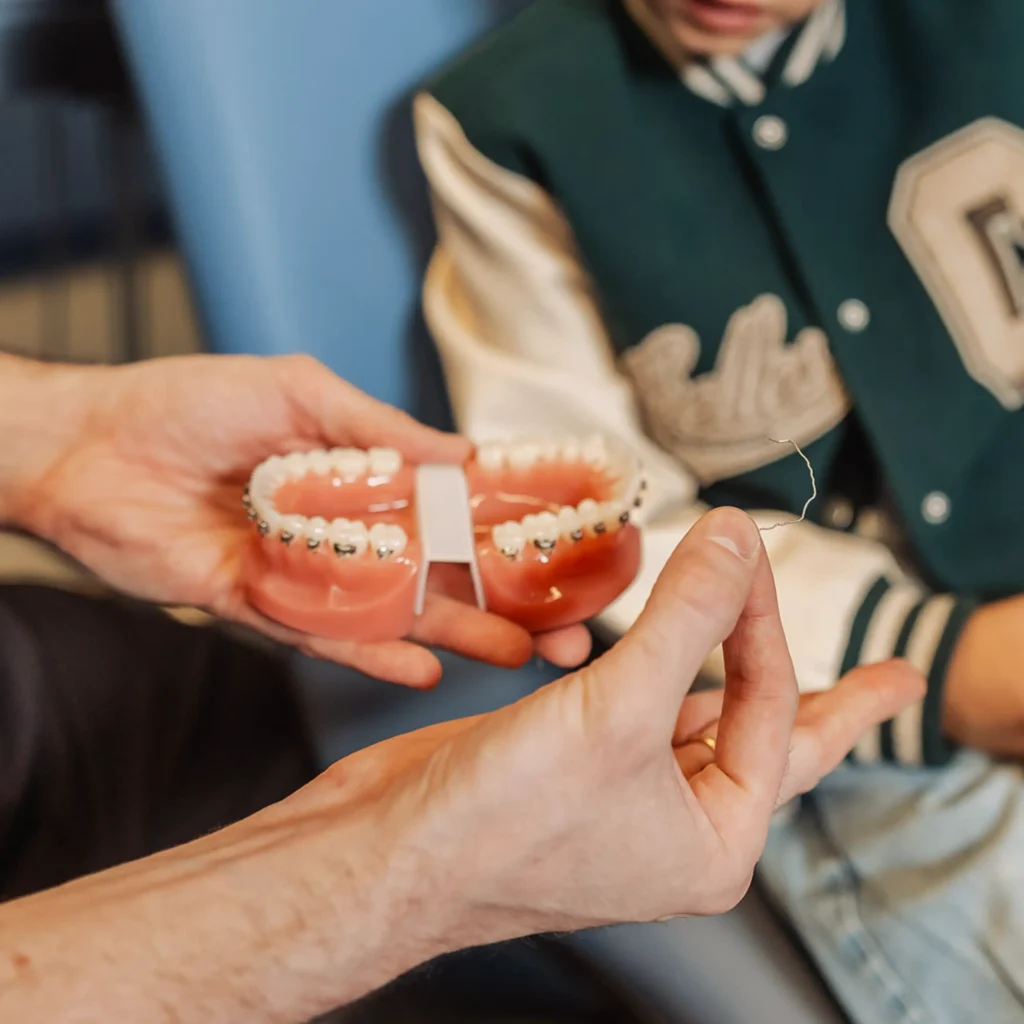
Fixed braces are the most common way for children and teenagers to get straight teeth. We bond self-ligating brackets—which hold the archwire in place without small rubber bands—in either metal or ceramic, with no difference in price. Nine out of ten teenagers choose metal, usually colored, and the color can be changed at each checkup. The treatment involves five archwires with deliberately low forces, changed every six to eight weeks. It usually takes one and a half to two years.
Removable braces for children and teenagers
Not every orthodontic treatment requires a fixed appliance. A removable aligner is placed on the teeth rather than bonded to them; it can simply be taken out for sports, playing music, and brushing teeth. It is most effective while the jaw is still growing, and in some cases, it prepares the teeth for fixed orthodontic treatment. They are manufactured by the certified specialist laboratory Klee, based on a scan rather than an impression. For removable appliances, we use the Sander II system because it is the only one backed by robust research data.

Retainers and Long-Term Stability
Treatment isn’t over once the braces come off. Teeth tend to shift back to their original positions, and the only way to prevent this is with a retainer. Our standard retainer is a thin wire placed on the inside of the teeth, digitally designed and bent to fit. If the risk of relapse is high, we also provide a removable nighttime retainer; replacement retainers are provided every two years. We provide a two-year warranty on the retainers we fit, with checkups once a year. If one breaks, we’ll see your child the very same day.
Aligners for Teens
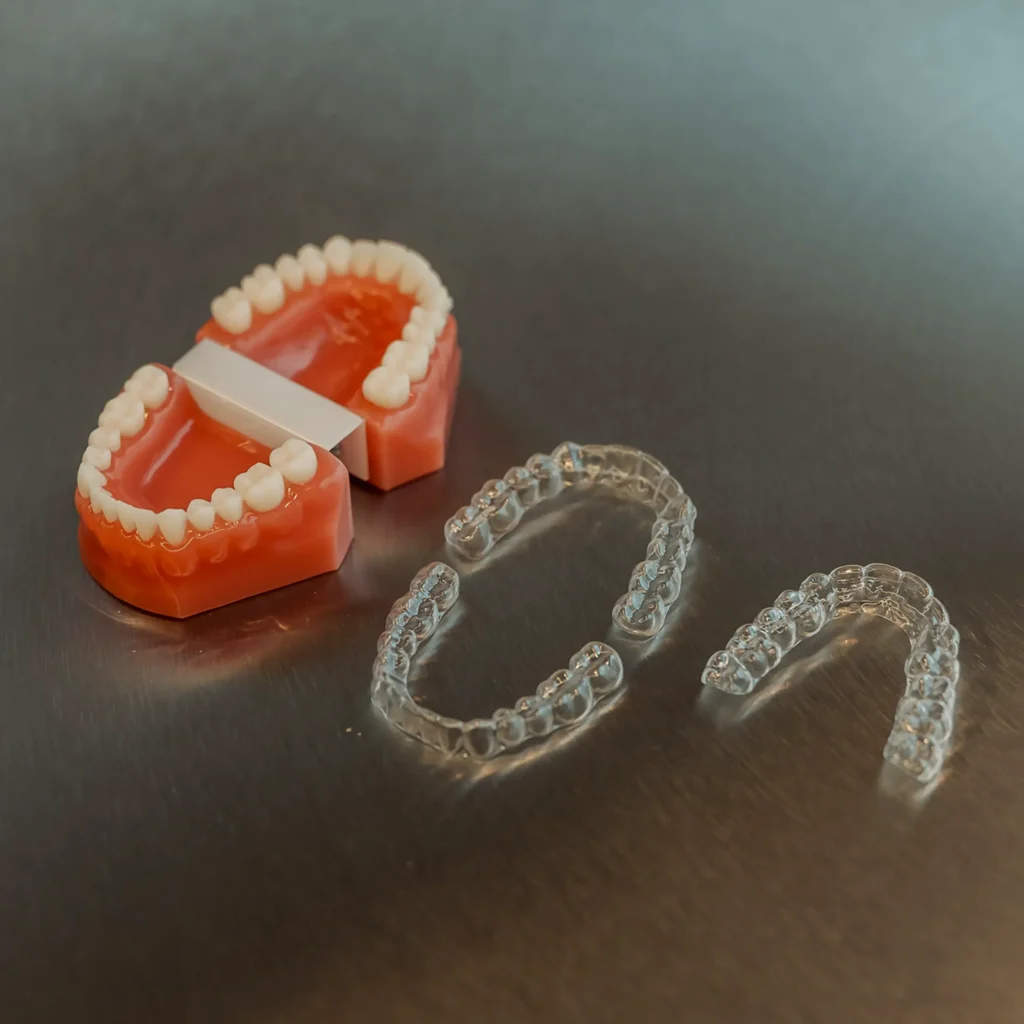
Aligners are virtually invisible braces for teenagers: clear aligners that move the teeth in small increments. Because they are removed for eating and brushing, oral hygiene remains as easy as before. However, they require consistency: they work in the mouth, not in the box. We work with SPARK; each aligner is worn for ten days, with checkups every eight to ten weeks. For younger children in the mixed dentition phase, aligners do not provide enough stability, so we use removable or fixed braces in those cases.

Teeth-Grinding Splints for Children and Adolescents
Many children grind their teeth at night, and this is usually temporary and harmless, especially during the transition to permanent teeth. Therefore, we don’t treat the sound itself, but only intervene when consequences become apparent: worn-down tooth edges, sensitive teeth, or morning jaw stiffness. If a mouthguard is recommended, it’s custom-made based on a scan and worn at night. We check during follow-up visits every six to ten weeks to ensure it still fits as the child grows. We’ll discuss together beforehand whether it’s necessary at all.
CMD & TMJ Pain in Children and Adolescents
Jaw pain, a clicking jaw joint, or discomfort while chewing can also occur in adolescents. Our goal is to help your child chew without discomfort and open their mouth wide again. To achieve this, we examine mouth opening, the temporomandibular joints, and the masticatory muscles, and determine whether the symptoms originate in the temporomandibular joint, the masticatory muscles, or have another cause. If a problem is identified, treatment begins with the simplest measures—namely, a splint and exercises. Anything beyond that is not the first-line treatment for this age group.


Mini Implants & Mini Pins for Teens
Some tooth movements require an anchor that does not move along with the teeth. For this purpose, we use mini-screws—also known in orthodontics as minipins, mini-implants, or TADs: small titanium screws that remain in the bone for the duration of treatment, often in the palate, and are removed afterward. For your child, this primarily means that an external archwire is not needed and the outcome does not depend on how consistently elastics are worn. Whether mini-screws are appropriate for your child’s specific case will be determined during the planning phase before treatment begins.
Lingual Braces for Teens
With lingual braces, the brackets are placed on the inside of the teeth, so they’re barely visible from the outside. We use the WIN system, and we’re upfront about who it’s intended for: people with a deep bite caused by the position of the jaw itself. For most teenagers, colored metal brackets or aligners are a better fit, and we’ll let you know if that’s the case. The first few weeks take some getting used to, but your tongue and speech will gradually adjust.


Early Treatment and Palatal Expansions in Children
Early Treatment and Palatal Expansions in Children
It’s a good idea to have an initial evaluation around age six, but treatment is only provided if the findings warrant it. The advantage of this time frame is that, as long as the jaw is still growing, some issues can still be resolved without surgery. If the upper jaw is too narrow, we widen it using a palatal expansion appliance, custom-made based on a scan. If the palatal suture has already closed, there is a bone-anchored alternative. For the initial consultation, we have a dedicated children’s consultation room, with appointments scheduled for half an hour.
Planning Orthodontic Treatment
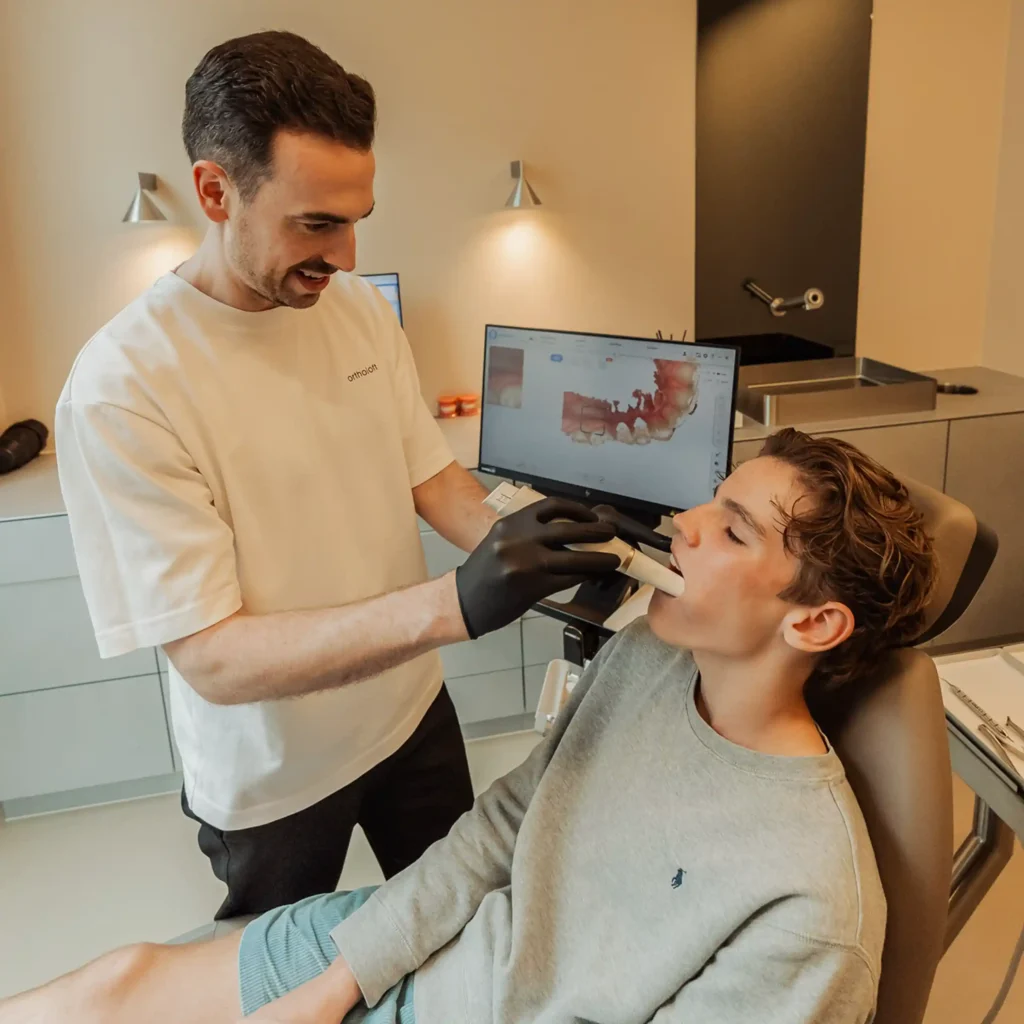
The intraoral scanner captures images of your child’s teeth in about three minutes—without impression material and without causing gagging. In addition, we take a lateral cephalometric X-ray, a panoramic X-ray, and single-tooth X-rays in-house, as well as a photo record using an iPad. We plan the treatment on the screen, using model analysis and simulation, before any teeth are moved. We’ll explain the results to you during the treatment planning consultation—in a way that’s easy to understand—before you make a decision.
Teeth Cleaning with Braces
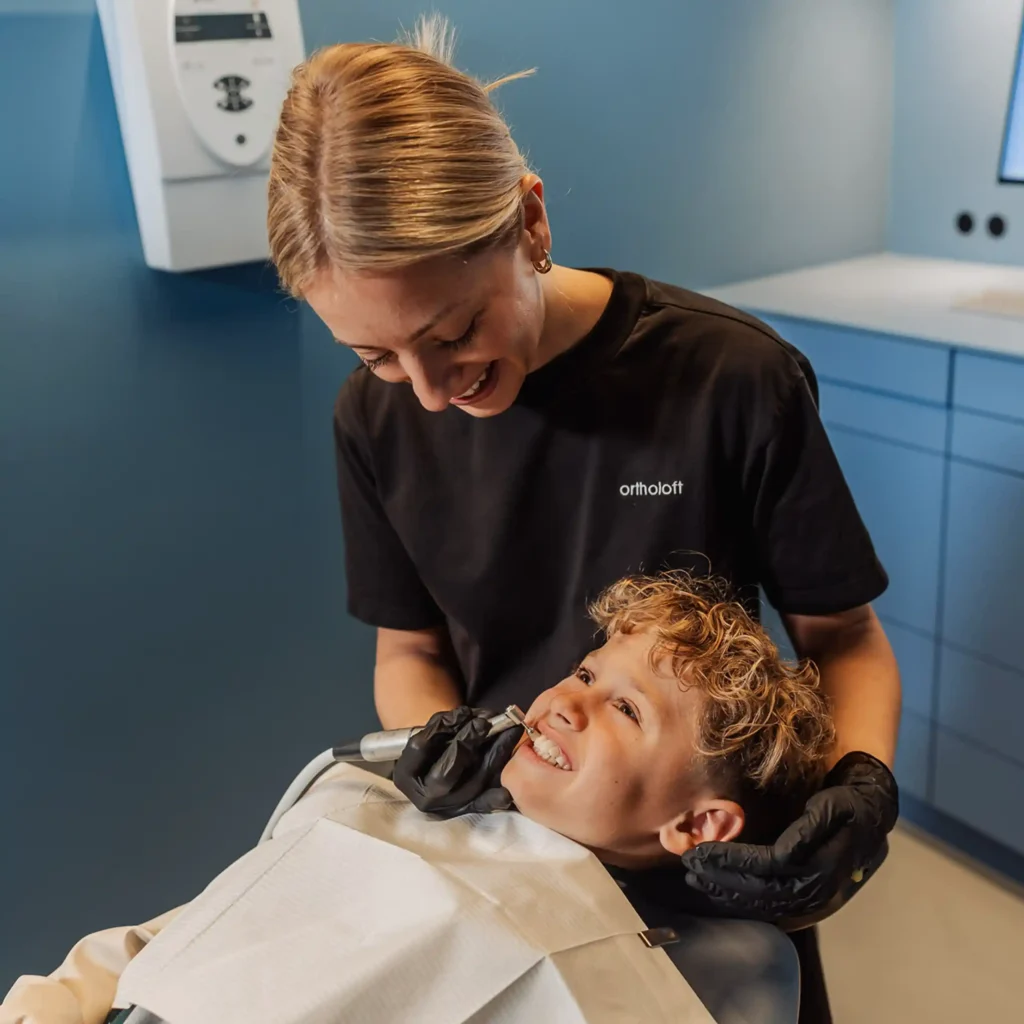
Plaque tends to accumulate more easily around brackets and archwires, and this is exactly what causes white spots on the enamel. That’s why professional teeth cleaning is part of the treatment: recommended four times a year and included in the treatment package, using a removable archwire and a powder jet device with an extra-fine powder. In addition, we apply fluoride, which remains effective for six to nine months, and when the braces are fitted, we’ll show your child how to keep their teeth and braces clean.