

Aligners are designed to do one thing above all else: move teeth without drawing attention to the treatment during daily work life. This is precisely the concern that brings most adults to us. Clear aligners work well for many cases, but not for everyone. A diagnostic evaluation by an orthodontist in Munich determines where the line is drawn, which is why every aligner treatment at ortholoft on Elisabethplatz begins with this step. We work with the SPARK clear aligner from Ormco and print some of the aligners ourselves. Before we get into suitability, duration, and costs, it’s worth taking a look at what such an aligner actually does from a technical standpoint.
Table of Contents
- What aligners are, and how an aligner tray moves teeth
- Who Can Use Aligners?
- SPARK and rails manufactured in-house
- The Process, from the Scan to the Final Splint
- How long aligner treatment takes and how often you'll need to come in
- Straight Teeth Without Fixed Braces: A Comparison of Options
- What's Included in Aligner Treatment at a Specialist Dentist's Office
- Aligners at an Orthodontist in Munich: Appointments That Fit Into a Workday
- Initial Consultation for Aligner Treatment
- Frequently Asked Questions About Aligners

What aligners are, and how an aligner tray moves teeth
An aligner is a thin, clear plastic dental tray that fits your teeth precisely. It is about half a millimeter thick and is thermoformed from a printed model of your jaw. It covers the entire row of teeth and applies gentle pressure at specific points. Each aligner moves your teeth a small amount, and then you move on to the next one. With us, you change the aligner every ten days. Depending on your initial situation, this means you’ll use between twenty and forty aligners over the course of your treatment.
Fixed braces, aligners, or a combination of both: Aligner treatment is fundamentally different from fixed braces. There are no brackets or wires; you remove the aligner to eat and brush your teeth, and no one can tell at first glance that you’re undergoing treatment. Aligner treatment with us takes about twelve months on average. For many adults, this makes it the first step toward orthodontic treatment—something they couldn’t have imagined doing with fixed braces.
Aligners, invisible braces, clear braces: same thing, three names
There are several names for this same treatment. The most common are “invisible braces” and “clear braces”; in specialty stores, the aligners are called “clear aligners,” and colloquially, people refer to them as “dental aligners,” “aligner trays,” or “aligner braces.” They all mean the same thing: a series of transparent aligners that gradually move the teeth into place. That is exactly what aligner therapy is. You rarely hear the English term “clear aligners” in the dentist’s office.
When it comes to the word “invisible,” precision is key. The aligner is barely visible in everyday life because it is transparent and fits snugly, but a keen eye can still spot it up close. Anyone looking for an invisible aligner usually means exactly that: a correction that doesn’t stand out in their daily work life. For many adults, an invisible aligner is the very reason they decide to begin treatment in the first place.
A clear aligner is always used for only one stage of treatment, and a new one is made for the next stage. If a clear aligner is needed only for the lower jaw, we treat only that area. Typically, however, clear aligners are used for both jaws, because otherwise the bite will shift.
Attachments: Why Clear Braces Alone Aren't Enough
In order for a tooth to move in a controlled manner, the aligner needs something to grip onto. That’s why we bond small, tooth-colored protrusions—called attachments—to individual teeth. In some cases, this is accompanied by a minimal reduction of enamel to create space. We’ll show you both of these steps in advance using a foam model.
A bracket alone wouldn't have enough force to move a tooth. We need to increase the surface area of the tooth so we can grip it at all. That's exactly what attachments are for, and I show them to every patient on a model beforehand.
Dominik Pfeil, D.D.S., specialist in orthodontics, owner of the ortholoft practice
Who Can Use Aligners?
Moving teeth with aligners works for crowding, gaps, rotated front teeth, and many types of malocclusions. Even if your teeth have shifted slightly since a previous treatment, aligners are often the gentler way to correct the issue. What an aligner can do for your teeth depends on the diagnosis, not on your personal preference. The key factors are the position of the root, the available bone space, and the type of movement required: Tilting a tooth is easier than moving it along with its root or rotating it around its own axis. That’s why two front tooth gaps that look identical don’t necessarily mean they’ll require the same treatment approach. Relapses following treatment during adolescence are the most common reason for seeking treatment. As orthodontists, we also provide these corrective treatments for patients in Bogenhausen and Arabellapark, because front tooth correction can be planned with eight to ten weeks between checkups.
One group benefits in particular. People who play a wind instrument find the aligner much easier to use than fixed braces because it doesn't press against the inside of the lip and doesn't interfere with their embouchure.
So much for suitability. It has its limitations, and we'd rather address those during the initial consultation than during the planning meeting.
When Aligner Treatment Reaches Its Limits
We do not use aligners for extensive prosthetic restorations. Crowns and bridges do not provide sufficient stability for the aligner, and attachments do not adhere as well to ceramic as they do to enamel.
The one true contraindication is a pronounced, skeletal deep bite. In such cases, the lingual technique is superior, and we say so openly rather than trying to treat it with aligners.
When the teeth are closed, the incisors are usually offset by one to two millimeters. For patients with very strong bites, the force of an aligner isn't enough to correct a true deep bite. In that case, I'll explain this, and we'll discuss the lingual technique.
Dominik Pfeil, D.D.S., specialist in orthodontics, owner of the ortholoft practice
For teenagers, we only treat them with aligners at the express request of their parents. The aligners are effective only as long as they are worn, and compliance is too unreliable in this age group. For teenagers, fixed braces are generally the more reliable option.
Clear Braces: The Drawbacks Explained
One of the drawbacks of aligners is precisely this reliance on your cooperation. If you don’t wear the aligner often enough, treatment will take longer—and no one will notice this sooner than you. On top of that, there’s an adjustment period of one to two weeks during which your speech may sound strange and the aligner may feel tight. Both of these issues will pass, and we’ll let you know about them in advance. An orthodontic aligner simply isn’t a device that works without your cooperation.
If you read about people’s experiences with clear aligners online, these are the two topics that come up most often. Such reports are isolated cases; your diagnosis is what matters most. A common misconception concerns the aligner itself: It is not a retainer but an active device, and it is intentionally designed to fit snugly. Anyone weighing the disadvantages of clear aligners against those of fixed braces should therefore not pit comfort against comfort, but rather cooperation against visibility. Dr. Pfeil, an orthodontist in Munich, will tell you which of these applies to your specific case after your diagnosis.
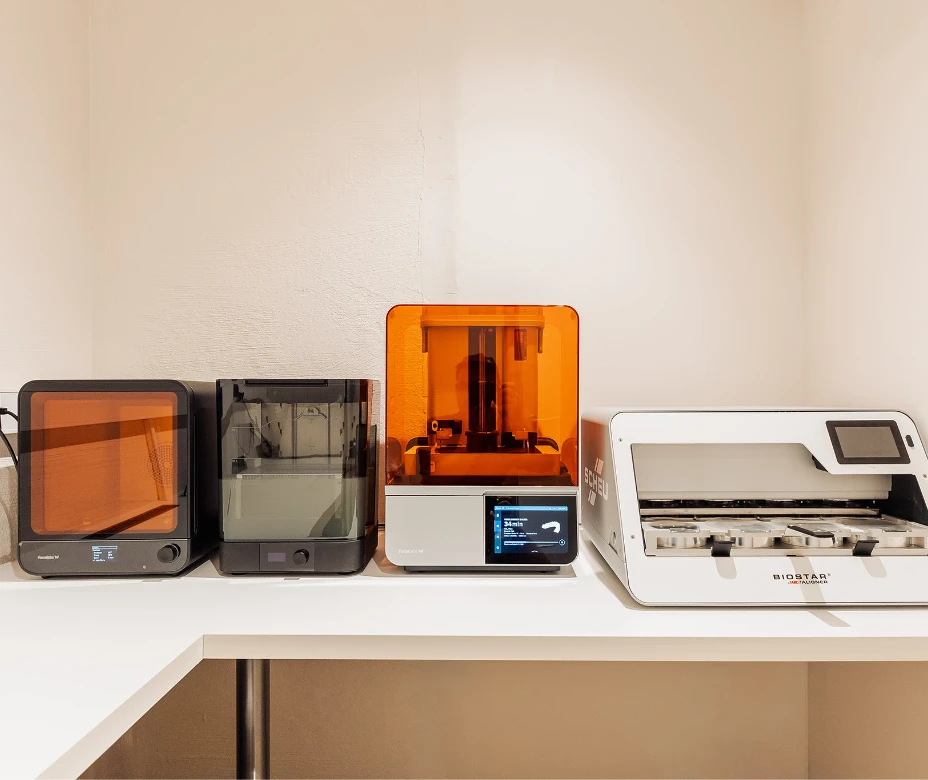
SPARK and rails manufactured in-house
We work exclusively with a single manufacturer’s system: SPARK by Ormco. Dr. Dominik Pfeil, D.D.S., an orthodontist in Munich and a specialist in orthodontics, is the sole practitioner here and holds the highest user status awarded by the manufacturer for SPARK. In our view, truly mastering a single system makes more sense than offering three side by side, because every planning software has its own limitations—and you can only understand those through experience. How well aligner therapy ultimately turns out depends less on the manufacturer than on the planning.
On top of that, there’s something that’s rare in Munich: We also manufacture the aligners ourselves. We scan them, design them in OnyxCeph, and print them on a Formlabs large-format printer—sixteen models per print run—all in-house. We use these in-house aligners for three purposes:
- Front tooth corrections on a "three-by-three" basis, that is, on the six front teeth
- Relapse, when the teeth have shifted again after a retainer breaks
- Finishing touches after treatment with fixed braces, when there are still minor details to address
In these cases, in-house production is faster because there’s no need to go through a manufacturer. What would otherwise take weeks can then be done in days. This means that a lost rail usually won’t require a second trip.
The Process, from the Scan to the Final Splint
At Ortholoft, treatment doesn’t start with a dental impression. The digital dental impression is created using an intraoral scan, which takes about three minutes. Each individual clear aligner—that is, each transparent dental tray—is later fabricated from this scan. There’s no impression material involved here. We don’t even have the trays for that in-house. Braces without an impression are therefore not a special case for us, but rather the standard, and the digital dental impression is more accurate for aligner planning anyway.
We’ll meet three times before treatment begins. During the initial consultation, we’ll discuss your concerns, examine you, and take a digital dental impression; if indicated, the initial diagnostic evaluation will follow immediately so you won’t have to come in a second time for the results. One to two weeks later, we’ll have a treatment planning meeting where we’ll go over the OnyxCeph simulation together. This is a planning tool and not a guarantee; it shows the intended sequence of movements. At the third appointment, we’ll place the attachments and provide you with your first aligner.
After that, you’ll change the aligner yourself every ten days, and follow-up appointments are scheduled every eight to ten weeks. If, at the end of the treatment, some teeth are still not properly aligned, a refinement phase with a new set of aligners will follow, and this is typically included in our treatment package.
How long aligner treatment takes and how often you'll need to come in
At ortholoft, aligner treatment lasts an average of about twelve months. For minor corrections to the front teeth, it can be significantly shorter; for complex cases, it can take longer. An aligner for adults does not take any longer than one for teenagers; the bone simply responds a little more slowly. We’ll let you know how long you’ll need to wear your aligners after the initial evaluation, not before.
What really determines the duration is how long you wear the aligner. The aligner only works when it’s in your mouth, and you should wear it for most of the day and throughout the night. You should take it out when eating, drinking anything other than water, and brushing your teeth. Clean it with cold water; aligner cleaning tabs are sufficient once a week.
Aligner treatment rarely goes exactly as planned, and that’s normal. Teeth move at different rates, and bone responds differently from person to person, which is why we check at every follow-up appointment to see if the aligners still fit. If the treatment is falling behind schedule, we make adjustments instead of simply continuing through the series. That’s exactly what refinements are for.
There are eight to ten weeks between checkups, which amounts to six visits per year. This keeps the trip to the orthodontist manageable even for patients in Garching, Unterföhring, and Ismaning. Once the final retainer is in place, the retention phase begins. We use fixed retainers as standard—digitally planned via RetainerHub—and offer a two-year warranty on the retainers we fit. With consistent wear and annual checkups, the results remain stable over the long term.
Straight Teeth Without Fixed Braces: A Comparison of Options
Anyone who wants straight teeth immediately thinks of braces. Today, however, there are several ways to straighten teeth, and aligners are one of them. A dental aligner for straightening teeth works on the same biological principles as fixed braces, but with a different mechanism: It moves each tooth in many small steps, acting on the entire row of teeth at the same time. This is a planned sequence, not a one-time procedure. Straightening your teeth therefore means following each step exactly; otherwise, the next-but-one aligner won’t fit properly.
Strictly speaking, there’s no such thing as straight teeth without braces, because even a clear aligner is a type of brace. However, it is certainly possible to have straight teeth without fixed braces. Technically, this type of device is called a dental correction aligner; in Bavaria, we sometimes still hear it referred to as “tooth regulation.” Anyone who wants to straighten their teeth without it being noticeable almost always ends up choosing an aligner. As a modern type of braces without brackets, it requires no adhesive bonds on the teeth at all, apart from the attachments. It does not replace the diagnostic process; rather, it is the result of that process.
A Dental Splint Instead of Braces: Weighing the Options on a Case-by-Case Basis
The choice between the two options is not merely a matter of personal preference. Fixed braces move the teeth more reliably and do not require patient cooperation. Clear aligners are more discreet and offer greater flexibility in daily life. The best option for each individual case is therefore determined by a diagnostic evaluation, which is performed by an orthodontist before the first aligner is made. As an alternative to fixed braces, aligners are a viable option in many cases, but not for very severe misalignments. Modern braces without brackets are therefore possible, but they are not necessarily the better choice in every case.
We’ve described the pros and cons in detail in the article “Aligners or Fixed Braces.” For adults whose jobs require a lot of speaking, clear aligners are the more practical option in most cases. Straight teeth are just as much of a goal for adults as they are for teenagers; it’s just that the path to achieving them is planned differently: Rotating a single front tooth often requires only a few aligners. This can be achieved at any age, and for most people, aligners are the more realistic alternative to fixed braces.
Tooth movement is possible at any age; the only difference is in the planning. The oldest patient I've treated was 83.
Dominik Pfeil, D.D.S., specialist in orthodontics, owner of the ortholoft practice
What's Included in Aligner Treatment at a Specialist Dentist's Office
In Munich’s orthodontic practice, aligners are not a product sold by mail order, but rather a treatment that includes diagnosis, planning, and follow-up. Here is a complete overview of what is involved before the first aligner is fitted and throughout the entire treatment process:
- In-office photographs, lateral cephalometric X-rays, and panoramic X-rays, along with cephalometric analysis
- Planning in OnyxCeph, reviewed together during the planning meeting
- Attachments and Enamel Reduction by the Dentist
- Checkup every eight to ten weeks
- Refinements are typically included in the treatment package
- Same-day emergency appointment for a loose attachment or a broken splint
- Retainer, annual checkup, two-year warranty
An orthodontist in Munich designs aligners not based on a photo, but on a diagnostic evaluation. An online aligner test cannot do this because it cannot see the roots or the bone, and therefore cannot replace a consultation. At ortholoft, aligners are not a product category but a treatment path: a professional reviews the progress if tooth movement isn’t proceeding as planned. If you’ve already started aligner therapy and are unsure, we’d be happy to provide a second opinion. The services provided by a specialist in orthodontics in Munich don’t end with the last aligner: they include four professional teeth cleanings per year, refinements (usually included), and a two-year warranty on the retainer.

Aligners at an Orthodontist in Munich: Appointments That Fit Into a Workday
Most of our patients undergoing orthodontic treatment are working professionals. Our practice in Munich-Schwabing is set up to accommodate this. Appointments are available on Mondays, Tuesdays, and Thursdays until 6:30 p.m., plus one Saturday a month by appointment. For those who have a hard time getting away during the week, it’s often easier to schedule a Saturday appointment than one on a weekday. You’ll usually wait five to ten minutes in the waiting area, and a follow-up appointment is a quick one.
Trams 27 and 28 stop right in front of the office. If you work in Maxvorstadt, you can get here in just a few minutes.
The office is located on the ground floor of an older building; the entrance is at street level and wheelchair-accessible, and you can park your bike right outside the door.
Initial Consultation for Aligner Treatment
At your first appointment, you’ll discuss your concerns with Dr. Dominik Pfeil, an orthodontist in Munich, and we’ll examine your teeth. This is followed by an intraoral scan—no impressions required. You’ll receive a clear assessment of whether aligners are a good option for you, along with a clear recommendation on how to proceed. For those with public health insurance and for self-pay patients, the initial consultation is free of charge and comes with no obligation. The consultation itself lasts five to fifteen minutes, but we’ll set aside half an hour so there’s plenty of time to answer your questions. Please bring any relevant documents with you: current X-rays, the name of your dental practice, and records from any previous orthodontic treatment.
You can reach us by phone at 089 20001060 or online through our appointment scheduling system; our office is located at Nordendstraße 56. You can find an overview of all orthodontic treatments in Munich on our page for adults.
Frequently Asked Questions About Aligners
What are aligners, and what is an aligner tray?
Aligners are clear plastic trays that are placed over the teeth and move them with gentle pressure. You will receive a set of aligners, not just a single tray. Unlike a partial denture, an aligner always covers the entire jaw. What an aligner can achieve in each individual case depends on the diagnosis: It is a tool for planned tooth movement, not a prosthesis.
Are aligners really invisible?
There is no such thing as an invisible brace in the literal sense. The aligner is invisible at a glance and barely noticeable in everyday life, but up close, you can see a transparent aligner. The attachments on the teeth are tooth-colored, but they are also noticeable upon closer inspection. We cannot promise you an invisible aligner in the absolute sense, but we can certainly promise you one that is discreet. For most adults, this is exactly what they mean when they ask about invisible braces for adults.
For which types of misaligned teeth are aligners suitable?
Crowding, gaps, rotated front teeth, and many types of malocclusion can be corrected with aligners. We do not use aligners for teeth with extensive crowns or bridges, and for severe skeletal deep bites, the lingual technique is the better choice. The initial diagnostic evaluation determines which teeth can be moved and by how much.
What are the disadvantages of aligners?
The disadvantages of aligners can be summarized in three points. The aligner only works when it is worn, and that means more hours a day than many people expect. During the first one to two weeks, they can feel tight, and speech may sound unusual. And for very severe misalignments, the limited force they can exert is a drawback of clear aligners. However, a lack of precision is not one of the disadvantages of aligners—that depends on the treatment plan. Anyone looking for information on aligners should therefore focus on the diagnostic evaluation rather than on reviews.
How long does aligner treatment take, and how many hours a day do I need to wear the aligners?
On average, about twelve months. How long braces actually stay on in adults depends on the diagnosis and how consistently they’re worn. For simple front-tooth correction, treatment can take as little as a few months; for complex bite irregularities, it can take up to two years. Aligner therapy with refinement takes correspondingly longer than the originally planned series. The aligners must be worn in the mouth both day and night and should only be removed for meals and when brushing your teeth. If you regularly leave them out for extended periods, you’ll prolong the treatment. That’s the most honest thing we can say about aligner therapy.
How do I clean my aligners, and do I need aligner cleaning tablets?
Use cold water and a soft brush, without toothpaste, because otherwise the plastic aligner will become dull. Aligner cleaning tablets from the drugstore can be used, but they aren’t necessary every day—once a week is enough. Rinse the aligner thoroughly afterward. The brush is not a substitute for the tablets. Hot water warps the plastic, and you should brush your teeth before putting the aligner in; otherwise, you’ll trap plaque under the aligner.
How much does a dental splint for adults cost, and does health insurance cover it?
For adults, aligner treatment is generally a service that patients must pay for out of pocket; statutory health insurance only covers the cost in cases of severe malocclusion. The cost of aligners for adults depends primarily on the number of aligners required and, consequently, on the complexity and duration of treatment. It’s not possible to give a general estimate in advance of how much a dental aligner will cost in Munich; we’ll provide the total amount in your treatment and cost plan on the day of your consultation. Interest-free installment payments over up to twenty-four months are available. All details can be found on our pricing page.
What happens after the treatment?
The teeth are stabilized. At Ortholoft, the standard is a fixed retainer, digitally designed using RetainerHub; if there is a high risk of relapse, a removable retainer is also used. Retention checkups are performed once a year, and we offer a two-year warranty on the retainers we fit.
At forty, fifty, or sixty, am I too old for orthodontic treatment?
No, teeth can be moved at any age. At the orthodontist’s office in Munich, the diagnosis—not the year of birth—is what matters. Straight teeth are just as achievable for adults as they are for teenagers; the only difference is the treatment plan. A dental aligner for adults takes into account existing dental restorations, the gums, and the bone, which is why a comprehensive evaluation is the first step. Technically, it’s no different from the ones used for teenagers, and that’s exactly why invisible braces for adults are in such high demand.
Aligners or traditional braces—which is a better fit?
That depends on the diagnosis. Strictly speaking, it’s not possible to straighten teeth without braces, because even a dental aligner is a type of brace. However, it’s often possible to straighten teeth with aligners—even at forty or fifty—and for adults, having straight teeth is no different a goal than it is for teenagers: it’s just a more discreet one, with a dental aligner for straight teeth instead of metal in plain sight. Anyone who wants to straighten their teeth without metal braces and wires will end up with clear aligners; those who ask about teeth straightening usually mean the same thing. Fixed braces, on the other hand, don’t require any cooperation from the patient and move the roots more reliably. We’ll weigh the options to determine what’s best for each individual case during the treatment planning consultation. For severe misalignments, fixed braces remain the safer choice.