

Lingual braces work from the inside: the brackets and archwire are placed on the inner surface of the teeth, leaving the front of the teeth visible. This is the most complex fixed treatment we offer at our practice. At ortholoft, your orthodontic practice near Tengstraße, we use them for a narrow range of cases—specifically, for true deep bites. If you’re considering lingual braces because they’re discreet, we’ll first assess whether aligners might be a quicker way to achieve the same result. And both approaches start with the same question: What is mechanically possible on the inner surface? In Munich’s orthodontic community, this is a specialized treatment option rather than standard care.
Table of Contents
- What Lingual Braces Are and How They Work from the Inside
- The WIN System, and Why We Use It
- When the Lingual Technique Is Appropriate, and When Aligners Are the Better Choice
- Interior or exterior: the difference from fixed braces
- Speaking, Eating, Care: The First Few Weeks with Braces—From the Inside
- Procedure and Follow-Up for Lingual Braces
- Lingual Braces: Costs, Insurance Coverage, and Payment Options
- Lingual Braces at an Orthodontist in Munich: Appointments and Directions
- Initial Consultation for Lingual Braces
- Frequently Asked Questions About Lingual Braces
What Lingual Braces Are and How They Work from the Inside
Lingual braces are a type of fixed orthodontic appliance in which the brackets are bonded to the inner surfaces of the teeth. The mechanism is the same as with conventional braces: The brackets guide an archwire, and the archwire moves the teeth. The front of the teeth remains visible because the entire appliance is positioned behind the teeth. Lingual braces require more careful planning because there is less space on the inner surface and each tooth has its own unique shape.
The tongue plays a bigger role in this design than the lips do. It’s part of this design, and we address it early on: It takes time to get used to lingual braces, and how long that takes is determined by the tongue—not by sheer willpower.
Lingual Brackets: Brackets That Sit on the Inside of the Teeth
Lingual brackets are custom-made for each individual tooth. They are designed to be flat so they take up as little space as possible, and the manufacturer uses a computer-controlled robot to bend the corresponding archwires. Brackets on the inner surface sit closer to the tooth’s pivot point than brackets on the front surface, which is why even slight bends in the archwire have a significant effect. Brackets behind the teeth thus operate on different leverage principles—not weaker ones. Braces placed on the back of the teeth move them just as reliably as those on the front. Lingual braces are therefore not a compromise in terms of mechanics, but rather a different starting point for treatment planning. Lingual brackets of this design are also the reason why the cost is higher than that of conventional braces: each part is one-of-a-kind.
Braces on the inside, lingual braces, lingual technique: same thing, different names
There are several terms used to describe the same treatment, which makes research difficult. The most commonly searched term is “lingual braces,” while in professional circles it is called the “lingual technique.” “Lingual” refers to the side facing the tongue: the term describes the position, not the product. It always refers to the same thing: brackets on the back, archwire on the back, and nothing on the front.
The WIN System, and Why We Use It
Lingual braces are not off-the-shelf products. Each bracket is custom-made for a single tooth, the arches are bent by a computer-controlled robot, and both are manufactured in Germany. We work exclusively with the WIN system, a lingual braces system that is completely custom-made. There are several lingual systems on the market; they differ in terms of manufacturing and adjustment. In Munich, the WIN lingual system is the only one we use. In specialty stores, you’ll see terms like “WIN Lingual Technology,” “WIN Brackets,” or, for short, “WIN braces”—but they always refer to this one system.
In cases of deep bite, controlling the inclination of the front teeth is key. That's why I use a system in which the brackets are custom-made for each tooth, rather than a standard appliance.
Dominik Pfeil, D.D.S., specialist in orthodontics, owner of the ortholoft practice
Research has confirmed that the system provides this level of control, and the findings are available for review. A laboratory study published in *Head & Face Medicine* by Lossdörfer and colleagues in 2014 measured, for the WIN bracket-archwire combination, how precisely the inclination of the anterior teeth can be controlled—and this is exactly the property we need for a deep bite. The measurements were taken on a model; the rest is demonstrated by the progression in the mouth. That is why we check and make adjustments every eight to ten weeks, rather than letting a treatment series run its course.
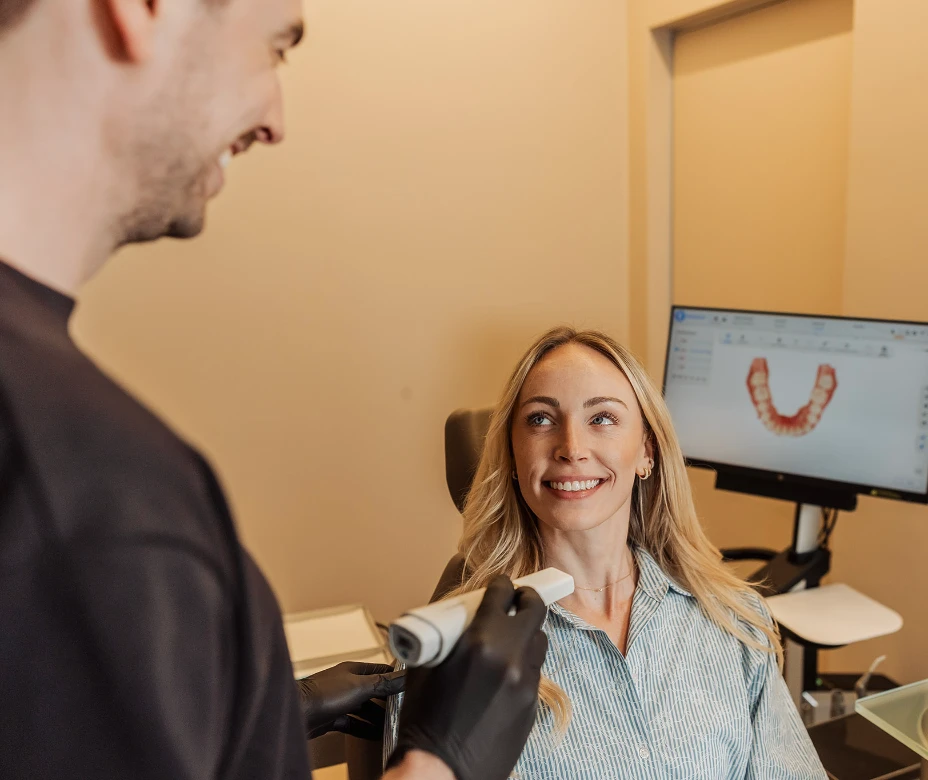
Ortholoft does not carry impression material—not even for emergencies. Scanning is done with the Aoralscan in about three minutes, and planning and analysis are performed in OnyxCeph. The accuracy of a fixed lingual brace depends entirely on the quality of the data used to create it. Anyone working in orthodontics—or “KFO” for short—who uses the lingual technique therefore needs accurate data before anything is even manufactured.
When the Lingual Technique Is Appropriate, and When Aligners Are the Better Choice
The indications are narrow, and that is a deliberate decision. We use lingual braces for true, skeletal deep bites—that is, when the front teeth overlap too much and the cause lies in the relationship between the jaws. In such cases, aligners are often insufficient because they lack the ability to control the inclination of the front teeth. For this reason, lingual braces for deep bites are not the standard treatment at our orthodontic practice in Munich, but rather an exception with a clear rationale. A simple overbite does not fall into this category; in such cases, other methods achieve the desired result more quickly. We explain the disadvantages of the lingual technique upfront: it requires more effort, is more expensive, and the tongue must first get used to having braces on the inside of the teeth.
For everything else, the reverse order applies. Anyone looking for invisible braces usually starts with aligners, and for many conditions, that’s the better choice: crowded teeth, gaps, rotated front teeth, or relapse after a broken retainer. Lingual braces come into play when aligners reach their limits. We’ll tell you this during your consultation even if you’ve come in hoping for the more complex solution. Lingual braces in Munich are therefore a clinical decision, not a matter of personal preference.
We do not offer a combination of the two—it’s either braces or the lingual technique. The decision is made after the initial diagnostic evaluation, not during the first part of the initial consultation. We’ve described in detail how these two approaches differ in everyday use in our article “Lingual Technique or Aligners.”
The lingual technique isn't the standard solution for everyone who wants discreet treatment. For many people, clear aligners are the better option, and I say so myself. I recommend lingual braces in cases where there is a true, skeletal deep bite.
Dominik Pfeil, D.D.S., specialist in orthodontics, owner of the ortholoft practice
Interior or exterior: the difference from fixed braces
Fixed braces placed behind the teeth and those placed on the front work using the same mechanism. The difference lies in their position, the complexity of their fabrication, and how they are billed.
For labial orthodontics, we use Empower brackets from American Orthodontics—self-ligating, available in metal and ceramic at no additional cost. The treatment involves five archwires: one circular archwire and two edge archwires made of thermoelastic nickel-titanium, followed by two edge archwires made of steel. These are changed at intervals of six to eight weeks, and we deliberately apply low forces. This type of treatment takes one and a half to two years.
Lingual braces are more complex because each bracket is custom-made, and they are a service that patients must pay for out of pocket. Lingual braces also require more maintenance; more on that below. And lingual braces put more strain on the tongue than braces placed on the front of the teeth. Therefore, lingual braces are not a matter of comfort, but rather a decision based on visibility.
Speaking, Eating, Care: The First Few Weeks with Braces—From the Inside
A promise that no one can keep is invisible. One that works is barely visible. From the front, the teeth remain visible, and during a conversation, the new braces usually catch the other person’s attention first—not the person you’re talking to. Anyone looking for hidden or aesthetic braces is referring to exactly this difference.
When speaking, the tongue touches the inside of the teeth for many sounds, and there’s now something there. According to the manufacturer, speech in adults returns to normal over the course of a few weeks. Experiences with lingual braces are described in various ways online; there are no reliable statistics on this, and anyone reading about the lingual technique is always reading about individual cases. When it comes to eating, the same rules apply as with any fixed orthodontic appliance: avoid hard and chewy foods so that nothing breaks off. Lingual braces also tend to accumulate plaque in areas where the tongue cannot reach it. A slight lisp in the first few days is common, and speech problems with lingual braces are almost always temporary. When speaking with lingual braces, it helps to consciously read aloud during the first week.
What's Different in the First Few Days
In the first few days, the tongue’s mucous membrane reacts—as the manufacturer also describes. In addition, after insertion and after each archwire change, you’ll feel pressure on your teeth, which subsides after a few days. So asking whether lingual braces cause pain is the wrong question; the right one is how long this sensation of pressure lasts. If your lingual braces cause pain that goes beyond this, give us a call—we’ll see you as soon as possible. And if experiences with lingual braces vary widely on this point, it’s because tongues have different levels of sensitivity. Speaking with lingual braces also feels different during this time, and any soreness at the tip of the tongue will subside as it heals.
I tell everyone in advance that the first few weeks are tough. Your tongue keeps bumping into the brackets, talking feels strange, and if you’re not expecting it, it can be a shock. If you know what to expect, you’ll get through this period just fine.
Dominik Pfeil, D.D.S., specialist in orthodontics, owner of the ortholoft practice
Cleaning the Internal Brackets
Braces on the inner side of the teeth require a different brushing technique than those on the front, because the toothbrush has to work against the angle. That’s why you’ll receive brushing instruction when they’re fitted—before plaque even begins to build up. With fixed braces, four professional cleanings per year are included in the treatment package; cleaning is performed with the archwire removed and using an EMS device with an extra-fine powder. Fluoride treatment is applied with a lasting effect of six to nine months. The final outcome of treatment with fixed lingual braces depends more on oral hygiene than on the technique itself.
Procedure and Follow-Up for Lingual Braces
At ortholoft, there are three appointments leading up to the start of treatment: the initial consultation, a follow-up meeting to discuss the treatment plan one to two weeks later, and the start of treatment. The initial consultation is free of charge for patients with public health insurance and for self-pay patients; it lasts five to fifteen minutes and is scheduled for half an hour. If treatment is indicated, the initial diagnostic evaluation takes place immediately afterward.
The diagnostic process includes an intraoral scan, a photo record taken with the dental iPad, and, when necessary, a digital lateral cephalometric X-ray, a panoramic X-ray, or a single-tooth X-ray. All of these services are performed in-house. We do not perform three-dimensional imaging. Treatment planning is based on this information, and only then are the internal braces fabricated.
After placement, we’ll see you every eight to ten weeks. We’ll schedule your next appointment before you leave the office, and we’ll see urgent cases on the same day after you call to make an appointment. The total duration of lingual orthodontic treatment depends on the findings and can only be determined after the initial diagnostic evaluation. Lingual braces don’t work any faster or slower simply because they’re on the inside of the teeth—it all depends on the specific findings.
Once the braces are removed, the phase that determines the final result begins. We use fixed retainers as standard—digitally planned via RetainerHub—and offer a two-year warranty on the retainers we place. Retention is monitored once a year.
Lingual Braces: Costs, Insurance Coverage, and Payment Options
The cost of lingual braces depends on the diagnosis and the complexity of the fabrication process. We use fixed prices based on three levels of complexity, and you’ll receive the total amount in your treatment and cost plan—which includes an easy-to-understand summary—both in advance and on the day of your consultation. This means you’ll know exactly how much lingual braces will cost before you make your decision. If only the upper jaw is treated, the cost of the lingual technique is lower than when both jaws are treated. The cost of WIN braces depends on the same diagnosis.
For adults, the lingual technique is generally a service that patients pay for out of pocket; statutory health insurance only covers it in cases of severe malocclusion. We therefore cannot provide a blanket guarantee of reimbursement; we will clarify this with you in advance. The cost of the lingual technique and the portion covered by your insurance are listed side by side on a single line in the treatment plan. The same applies to the cost of lingual braces under supplemental insurance. Because the lingual technique is a service paid for out-of-pocket and checkups are scheduled only every eight to ten weeks, the travel time is minimal—even from Schwabinger Tor.
You can pay in a lump sum with a 3 percent discount, in interest-free installments over up to twenty-four months, or on a pay-as-you-go basis. Payment processing is handled by Nelly Solutions; no Schufa credit check is performed. Since check-ups are scheduled at intervals of several weeks, the commute from Odeonsplatz is manageable, especially for a service you’re paying for yourself. The cost of lingual braces is primarily driven by the manufacturing process, as each bracket is custom-made and the number of teeth to be moved is a key factor. The fixed price includes checkups every eight to ten weeks and four professional teeth cleanings per year. We do not calculate the cost of custom-made lingual brackets on a per-tooth basis because the effort involved cannot be broken down that way. Therefore, there is no single price for lingual braces that applies to every case.
Lingual Braces at an Orthodontist in Munich: Appointments and Directions
Choosing braces that sit behind the teeth is a decision that deserves careful consideration. Anyone looking for lingual braces in Munich is usually looking for exactly that, and that’s where we begin. Dr. Dominik Pfeil, DDS, an orthodontist in Munich and a board-certified orthodontist, is the sole practitioner at ortholoft. The board certification is awarded by the Dental Association upon completion of advanced training. Over the course of his career, he has overseen approximately 2,000 orthodontic treatments.
The practice is located at Nordendstraße 56 in Munich-Schwabing, on the ground floor of an older building; access is at street level. You can park your bicycles right in front of the practice; there are no dedicated parking spaces. It’s just a few minutes’ walk from the Alter Nordfriedhof; you can get here via the U3 and U6 subway lines from Giselastraße. Appointments are available on Mondays, Tuesdays, and Thursdays until 6:30 p.m., on Wednesdays until 3:30 p.m., and on Fridays until 1:00 p.m., as well as one Saturday a month by appointment. You’ll typically wait five to ten minutes in the waiting area. Consultations are conducted in German and English.
You can find an overview of all treatments for adults on our section page. The article “How Do Braces Feel from the Inside?” describes what it’s like to wear braces behind the teeth in everyday life.

Initial Consultation for Lingual Braces
During the first appointment, Dr. Pfeil, an orthodontist in Munich, will determine whether treatment is indicated—not which type of braces to use. We’ll examine your bite, assess whether the deep bite is skeletal in origin, and let you know if lingual braces are the right choice. If the answer is no, we’ll be just as clear about that, and then we’ll discuss aligners.
You’ll leave the appointment with three things: an assessment of whether treatment is indicated, the next steps, and a realistic idea of what the treatment will require of you in your daily life. You won’t take an impression home with you—we don’t take impressions here. If treatment is indicated, the initial diagnostic phase begins right away so you don’t have to come back a second time. For those with public health insurance and self-pay patients, this initial consultation with the orthodontist in Munich is free of charge.
The consultation lasts five to fifteen minutes, but we set aside half an hour to ensure there’s plenty of time for your questions. We offer no-obligation consultations on lingual braces in Munich; you can schedule an appointment with an orthodontist by calling 089 20001060 or online. If you’re considering lingual braces in Munich, your first step with us is an examination—not a cost estimate.
Frequently Asked Questions About Lingual Braces
What are lingual braces, and how do they differ from braces on the front of the teeth?
Whether lingual braces are an option for you will be determined by the findings of your orthodontist in Munich. Lingual braces are fixed braces whose brackets are placed on the inner surface of the teeth. The mechanism is the same as with conventional braces: the brackets guide a wire, and the wire moves the teeth. The difference lies in the position and the effort involved: Lingual brackets are custom-made for each tooth individually, whereas for conventional braces we use prefabricated Empower brackets, which are available in metal and ceramic at the same price. Because the brackets are positioned closer to the tooth’s pivot point on the inner surface, even slight adjustments to the archwire have a significant effect there. Nothing is visible from the front.
How noticeable are clear aligners from the inside in everyday life?
From the front, the row of teeth remains visible, and the appliance is barely noticeable in everyday life. No braces are completely invisible—that would be a promise no one can keep: If you open your mouth wide, something may be visible, and your tongue will feel the brackets right from the start. If discreetness is your top priority and your diagnosis allows for both options, you should consider aligner treatment before making a decision. We’ll show you both options using a model and on screen.
How much do lingual braces cost?
The cost of lingual braces depends on the diagnosis and the complexity of fabrication. We use fixed prices based on three levels of complexity and will provide you with the total cost in your treatment and cost plan on the day of your consultation, along with an easy-to-understand summary in advance. The cost of lingual braces is higher than that of conventional braces because each bracket is custom-made. For adults, this is generally a service that patients pay for out of pocket. If you’re looking for information on the cost of lingual braces in Munich: We do not list prices on our website, but rather in the treatment and cost plan specific to your case.
Do braces hurt on the inside?
After insertion and after each archwire change, you may feel some pressure on your teeth, which will subside after a few days. In addition, the mucous membrane on your tongue may react during the first few days because there is something there that wasn’t there before. Our goal is to minimize discomfort, and we’ll provide you with wax for the initial period. If any discomfort persists or worsens, please call us—we’ll see you as soon as possible. It would be unrealistic to promise that you won’t feel anything at all with fixed braces.
How long does treatment with lingual braces take?
The duration of lingual braces treatment depends on the diagnosis, not on the position of the brackets. We’ll tell you how long the lingual technique will take after the initial diagnosis—not before—because any estimate beforehand would be just a guess. As a general guideline: Fixed orthodontic treatment using conventional braces takes one and a half to two years. We schedule follow-up appointments every eight to ten weeks, and at each appointment we check to see if the treatment is progressing as planned.
Can I speak normally with braces in the back?
In the first few days, your pronunciation will change because, for many sounds, your tongue makes contact exactly where the braces are now. According to the manufacturer, speech returns to normal within a few weeks for adults and more quickly for teenagers. If your job requires you to speak a lot, you should plan ahead and not start treatment the day before a presentation. Braces on the back teeth require a bit of patience, and we’re telling you this in advance—not after the fact.
How effective are fixed braces on the inside compared to the outside?
Both methods use brackets and archwires and can produce the same movements. For the combination of bracket slots and arches in the WIN system, control of anterior tooth inclination has been documented in a laboratory study—though on a model rather than in the mouth—and the authors themselves caution against direct application of these findings. There are no robust comparative studies in this form examining the effectiveness of the lingual versus labial approach. Therefore, our decisions are based on clinical findings and indications, not on promises of effectiveness.
For whom is the lingual technique not suitable?
We use them for true, skeletal deep bites. If the issue can also be resolved with splints, we recommend aligners—and this applies to many situations: crowding, gaps, rotated front teeth, and relapse following a broken retainer. Even in cases involving extensive crown or bridge restorations in the front teeth area, we carefully assess whether bonded brackets would be suitable. We do not offer a combination of aligners and the lingual technique.
What does health insurance cover?
For adults, statutory health insurance only covers severe malocclusions; in all other cases, treatment is a self-pay service. We cannot provide a blanket guarantee of reimbursement, as it depends on the diagnosis and your insurance status. If you have private or supplemental insurance, you will receive the treatment and cost plan digitally and can submit it before making a decision. Interest-free installment payments over up to twenty-four months are available; the process is handled by Nelly Solutions.
What happens once the braces are removed?
Then the retention phase begins, and that’s what determines the outcome. Our standard approach is a fixed retainer, digitally planned using RetainerHub and then fitted, supplemented by a removable retainer if the risk of relapse is high. We offer a two-year warranty on fitted retainers, with checkups once a year. With consistent wear and annual checkups, the results remain stable in the long term. If a retainer comes loose, we’ll see you promptly, even if the treatment was completed some time ago.