

Fixed braces for children are the most common orthodontic treatment during the mixed dentition phase, and for adolescents, they typically offer the greatest flexibility in treatment options. If you’re looking for a pediatric orthodontist in Munich, ortholoft in Schwabing-West—just a few minutes’ walk from Josephsplatz—is a practice specializing exclusively in orthodontics. Dr. med. dent. Dominik Pfeil, an orthodontist in Munich and a specialist in orthodontics, is the sole practitioner here, with approximately 2,000 orthodontic treatments to his credit throughout his career. The initial consultation is free for patients with public health insurance and for self-pay patients, and there are three appointments before treatment begins. On this page, you can read about the recommended age for starting fixed braces, how the fitting process works, how long your child will wear them, and what your health insurance will cover. You can find an overview of all treatments for children and adolescents on our dedicated page.
Table of Contents
- When is it appropriate for children to get fixed braces, and when is it not yet appropriate?
- How do you get fixed braces? The process at a pediatric orthodontist's office in Munich
- Fixed Braces for Children and Teens
- How long do you wear fixed braces, and how often do you come in for appointments?
- Costs, KIG Classification, and Health Insurance Coverage
- Caring for Your Teeth with Fixed Braces, and What Keeps Them Stable Afterward
- Pediatric Orthopedics in Munich-Schwabing: How to Find Us
- Initial Consultation on Fixed Braces for Your Child
- Frequently Asked Questions About Fixed Braces for Children
When is it appropriate for children to get fixed braces, and when is it not yet appropriate?
It’s a good idea to schedule the first visit to a pediatric orthodontist around age six, as soon as the first large molar has erupted. That doesn’t mean treatment will begin right away. At this age, we only provide treatment if there is a functional impairment or if growth-related factors warrant it.
The timing of when to place fixed braces depends less on the calendar than on the progression of tooth replacement. The actual peak treatment period is around age 11—starting at age 10 for girls and age 11 for boys. Therefore, the decision about when fixed braces are the right step is made as treatment progresses. When it comes to fixed braces, age is thus a guideline rather than a fixed deadline. In pediatric orthodontics, remaining growth is the most important factor in treatment planning, and part of that is determined by family history. Jaw shape and bite alignment are strongly hereditary, which is why Dr. Pfeil, an orthodontist in Munich, also observes the parents and asks them questions during the consultation. If a family has a history of the lower jaw continuing to grow long and strong, the optimal timing for treatment is delayed, because any correction started too early would be overtaken by continued growth. A lateral panoramic X-ray then reveals how far the development has actually progressed.
At what point do you get fixed braces, and at what point do you actually need them? These are not the same thing. Fixed braces become an option as soon as enough permanent teeth have erupted. They are only necessary when a dental evaluation justifies them, and that is precisely what determines the timing. What parents see themselves are permanent teeth erupting crookedly, visible crowding, or a jaw that’s noticeably set back. Much of this is a normal part of the mixed dentition phase, which is why an examination is needed to determine when fixed braces are actually necessary. We’ve described this in detail in our article “At What Age Should You See an Orthodontist?”
We start monitoring at age six. But that doesn't mean treatment will begin anytime soon. I don't use any orthodontic appliances if there's no reason to do so at this stage. For most children, the right time is around age eleven, and until then, we'll continue to monitor them.
Dominik Pfeil, D.D.S., specialist in orthodontics, owner of the ortholoft practice
Treatment therefore begins during the first years of high school—a time when there are already so many new experiences. That is why we deliberately schedule follow-up appointments for the afternoon.
And sometimes the next step involves a different type of appliance. If the upper jaw is too narrow, we widen it using a palatal expansion appliance, cast based on an intraoral scan and manufactured by the certified German specialty laboratory Klee. If the lower jaw is set back, we use the Sander II appliance, the only removable appliance for which, in our view, there is robust evidence. However, we do not use what parents may know as “plates,” “braces,” or “aligners.” Dr. Pfeil comments: “I see no robust evidence for removable aligners, which is why I don’t use them.” We’ll provide you with specific details regarding the duration of treatment with a removable appliance and the frequency of wear during the treatment planning consultation. In many cases, a fixed braces system follows afterward and completes the rest of the correction.
How do you get fixed braces? The process at a pediatric orthodontist's office in Munich
How long does it take to get braces? Before treatment begins, we’ll meet three times: an initial consultation, a follow-up to discuss the treatment plan one to two weeks later, and the start of treatment. The initial consultation takes five to fifteen minutes, is scheduled for half an hour, and is free of charge for both patients with public insurance and those paying out of pocket. If treatment is indicated, the initial diagnostic evaluation follows immediately; in that case, no additional appointment is necessary. The treatment process for fixed braces is therefore brief: evaluation, planning, and placement.
We see children in a separate, smaller room. The large dental chair in front of the big mirror was too imposing for them; in the smaller room, they are visibly more relaxed. You fill out the medical history form on an iPad; the practice operates paperlessly and will print it out upon request. Before the consultation, the assistant clarifies your concerns in advance so that the dentist enters the room fully informed.
The dental evaluation is performed using an intraoral scan, which takes about three minutes. We do not use impression material here. We don’t even have the trays for it on-site. For further diagnostics, we offer in-house digital lateral cephalometric X-rays, panoramic X-rays, and single-tooth X-rays, which are evaluated using OnyxCeph software. You can come in directly for an initial consultation; a referral is not necessary. If your child is already under dental care, we’ll coordinate with their dentist to ensure that checkups and orthodontic treatment are seamlessly integrated.
Fixed Braces for Children and Teens
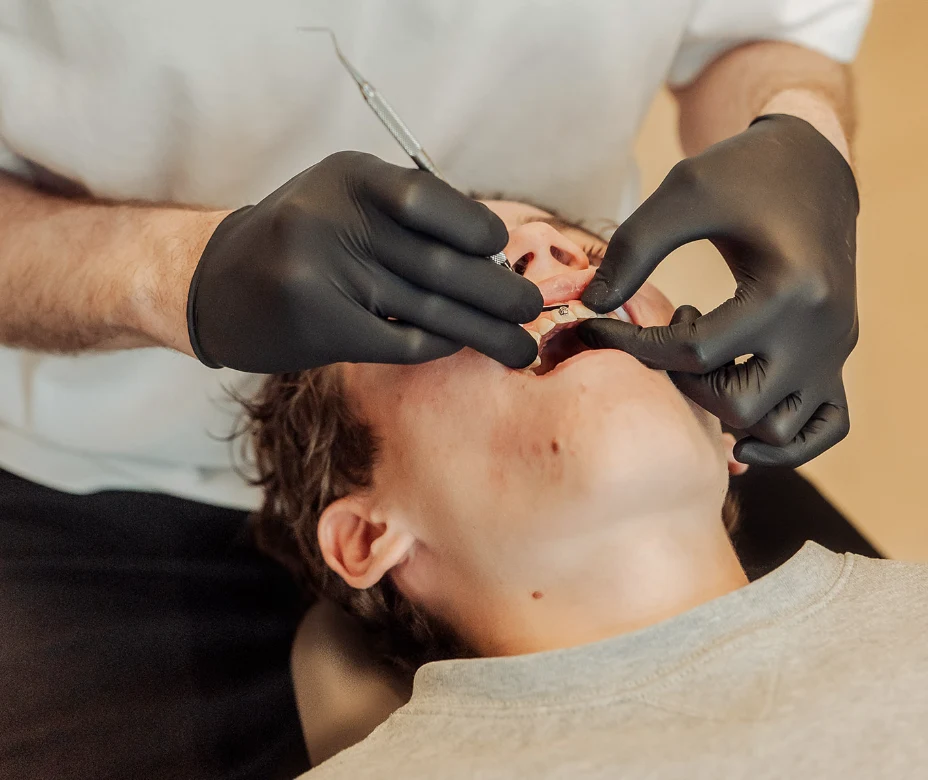
Children and adolescents are the group for whom fixed braces are designed. They work around the clock, do not require patient cooperation, and can achieve tooth movements that are not possible with removable appliances. Fixed braces for children consist of two parts: the brackets, which are bonded to the teeth, and the archwire, which connects them and transmits force. Technically, they are called fixed braces. In southern Germany, we also hear terms like “Zahnklammer” or “Zahnregulierung,” and many families simply say “feste Spange.” They are all referring to the same type of appliance. How do fixed braces work? The archwire is inserted in a bent shape and naturally wants to return to its original form. It transfers this force to the teeth via the brackets, continuously and in small increments.
What are braces, and which ones are the best?
Brackets are small brackets that are bonded to the teeth. We use Empower brackets from American Orthodontics—self-ligating brackets available in metal and ceramic. Which brackets are best? From a technical standpoint, there is no difference in quality between the types that would justify a recommendation; therefore, for us, it comes down to aesthetics. Ceramic brackets cost us significantly more to purchase, but we still do not charge a different price for them. The decision should be up to you and your child, not your budget. For us, which brackets to use for fixed braces is therefore not a question of price. Fixed braces and bracket types are distinguished by material and closure mechanism. Both metal and ceramic brackets we offer are self-ligating. “Which brackets should I choose?” parents often ask at the end of the consultation. We recommend the option your child feels more comfortable with, because both work equally well from a technical standpoint.
What do braces look like once they’re in place? Small brackets on the teeth, a thin archwire running across them—that’s all you can see. When it comes to appearance, both boys and girls usually choose metal braces; about ninety percent of our teenage patients do, and they often opt for colored elastics. When do you get ceramic braces? Usually when teens want a more discreet option.
Self-ligating, five arches, wider spacing
The Empower brackets on a fixed braces system are self-ligating, which means the archwire is held in place by a clip inside the bracket instead of rubber bands. A fixed braces system without rubber bands in the traditional sense is therefore our standard; colored rubber bands are only used if your child wants them. Rings on the molars—technically called bands—are only used with fixed braces in cases where a bracket alone does not provide sufficient hold.
Over the course of the entire treatment, we use five arches: one round arch, two edge-form arches made of thermoelastic nickel-titanium, followed by two edge-form arches made of steel. Under normal circumstances, this achieves the treatment goal. The arches are not changed every four to six weeks, but at intervals of six to eight weeks or longer. From a technical standpoint, this means lower forces, fewer side effects, and a lower risk of root resorption. For you, this means fewer appointments per year. Self-ligating brackets are also colloquially known as “click brackets” because the clip makes an audible clicking sound when it closes. Parents also often ask about fixed braces with an archwire or a spring—they’re referring to additional components such as a palatal archwire or a compression spring, which are used to move specific teeth or open a gap. We use them when the diagnosis calls for it. The archwire’s thickness increases over the course of the five arches, from thin and flexible to strong and dimensionally stable.
Getting Fixed Braces: The Process, Duration, and the First Few Days
How are fixed braces fitted? The teeth are cleaned and roughened, then each bracket is glued on individually and the first archwire is inserted. No drilling is involved, and no anesthesia is used. How long does it take to fit fixed braces? At our office, it takes sixty to ninety minutes for both jaws, so your child shouldn’t have another appointment right after this.
How long it takes to fit braces also depends on whether both jaws are being treated or just one: for one jaw, it usually takes about an hour. The treatment plan will determine whether the braces are fitted on both the upper and lower jaws at the same time or initially on just one jaw. The procedure for fitting fixed braces is the same in both cases, and we’ll show your child beforehand, using a model, how fixed braces are attached.
The first few days afterward are the most uncomfortable—we’re telling you this up front, not after the fact. The lining of the mouth is more sensitive than the skin on the outside and needs a few days to adjust. Your child will be given protective wax, and if there’s significant pressure, eating something cold can help because it reduces the force exerted by thermoelastic arches. If a bracket comes loose or a wire is poking, give us a call—we’ll see your child the same day.
How long do you wear fixed braces, and how often do you come in for appointments?
Parents looking for an orthodontist in Munich for fixed braces almost always ask about the duration first. How long do you have to wear fixed braces? Usually one and a half to two years. How long you’ll ultimately have to wear fixed braces depends primarily on the diagnosis, as well as how the treatment progresses. Follow-up appointments are scheduled every six to ten weeks, and the next appointment is set before you leave the office. You’ll typically wait in the waiting room for five to ten minutes.
Can the duration of treatment with fixed braces be shortened? Only to a limited extent, and not by applying stronger forces. What actually shortens the duration of treatment with fixed braces are clean teeth, intact brackets, and keeping your appointments. That’s why we’ll tell you how long your child will ultimately need to wear fixed braces after the initial diagnosis—not before. Where tooth movement needs to proceed regardless of patient cooperation, we use mini-screws. These are small titanium screws that act as anchors in the jawbone and are removed after treatment. For your child, this means: no archwire, fewer appointments, and a more reliable result.
One treatment room is equipped with a double chair. That may sound like a minor detail, but it saves time during the most common types of appointments. Two quick checkups can be done side by side, and siblings can be seen in one afternoon instead of two. Appointments are available on Mondays, Tuesdays, and Thursdays until 6:30 p.m., plus one Saturday a month by appointment. For students at Willi-Graf-Gymnasium, this usually means they can schedule a checkup without missing class.
Since there are six to ten weeks between appointments, the trip is manageable even from neighborhoods farther away. As an orthodontist serving Neuhausen and Nymphenburg, the trip from Rotkreuzplatz to the practice is a manageable journey six times a year, not six times a month.
Costs, KIG Classification, and Health Insurance Coverage
For children and adolescents, statutory health insurance covers a portion of orthodontic treatment. Whether coverage is provided—and to what extent—depends on the KIG classification. KIG stands for “orthodontic indication groups,” a scale from one to five used to assess the need for treatment. The first step is to determine whether there is a medical indication. Starting at Level 3, statutory health insurance covers a portion of the costs. Anything below that is a self-pay service. We determine this classification during the initial diagnostic evaluation and explain it to you before you make a decision. If you’re looking for an orthodontist in Munich who accepts statutory health insurance, we’re here for you—we regularly treat patients with statutory health insurance.
In addition to the services covered by insurance, there are supplementary services that we discuss openly, such as smooth-surface sealing to protect the enamel and professional teeth cleanings during treatment. We prepare the treatment and cost plan on the very day of the consultation, with an easy-to-understand summary included at the beginning. Patients with private or supplemental insurance will receive it digitally in advance and can submit it to their insurer.
The cost of fixed braces depends on the diagnosis and severity classification, not on the type of brackets: The cost of metal and ceramic brackets is the same at our practice. The health insurance coverage model for braces covers medically necessary treatment starting at Grade 3; anything beyond that is a supplementary service, which we’ll discuss with you beforehand. You can pay in a single lump sum with a discount, in interest-free installments over up to twenty-four months, or on a per-service basis. Processing is handled by Nelly Solutions; no Schufa credit check is performed. If you’re looking for pediatric orthodontics in Munich and are primarily concerned about costs, you’ll find a complete explanation of KIG, copayments, and payment options on our costs page.
Germany is one of the few countries in Europe where health insurance covers orthodontic treatment. You should take advantage of this while it’s still available. And we’ll let you know in advance—not afterward—what your insurance covers and what it doesn’t.
Dominik Pfeil, D.D.S., specialist in orthodontics, owner of the ortholoft practice
Caring for Your Teeth with Fixed Braces, and What Keeps Them Stable Afterward
Plaque builds up around brackets, which can lead to white demineralization spots that don’t go away. That’s why we seal the smooth surfaces with BracePaste for every patient—even if no one asks for it—and explain the process beforehand. When braces are fitted, we provide brushing instruction so that proper care is established from the start, rather than having to be practiced only after the first spot appears. Four professional teeth cleanings per year are included in the treatment package for fixed braces; cleaning is performed with the archwire removed and using an EMS device with an extra-fine powder. Fluoride treatment is applied with a sustained-release effect lasting six to nine months.
White demineralization spots remain even long after the braces have been removed. That’s why I seal the smooth surfaces for every child—even if no one asks for it—and we explain this beforehand. For me, four cleanings a year are an integral part of fixed orthodontic treatment.
Dominik Pfeil, D.D.S., specialist in orthodontics, owner of the ortholoft practice
Once the brackets are removed, the phase that determines the final result begins. Today, any modern orthodontic system can straighten teeth. But they’ll only stay straight if there’s a plan. We use fixed retainers as standard, digitally planned via RetainerHub—from scanning and modeling to bending and placement. If there’s a high risk of relapse, we also provide a removable retainer. Retention checkups take place once a year, and we offer a two-year warranty on the retainers we place. With consistent wear and annual checkups, the results remain stable in the long term.
One of the most common questions asked at the end of treatment is how long to wear removable retainers after having fixed braces. The answer depends on the risk of relapse, and we’ll be honest with you—expert opinions on this vary. Retainer checkups are scheduled only once a year. As an orthodontist serving the Bogenhausen area, our practice is easily accessible from Arabellapark.

Pediatric Orthopedics in Munich-Schwabing: How to Find Us
Anyone looking for pediatric orthopedics in Munich-Schwabing or braces for their child is almost always referring to orthodontics. As pediatric orthodontists in Munich, we are a practice specializing exclusively in this field, and we’re located on the ground floor of an older building. Access is at ground level and barrier-free, which is not always a given in a neighborhood of older buildings.
Trams 27 and 28 stop right in front of the office; the nearest stop is Elisabethplatz. Hohenzollernplatz, served by the U2 and U8 lines, is just a few minutes’ walk to the west. You can park your bike right in front of the office. There is no parking available on the office premises.
Inside, the practice is divided by patient group and color-coded. The teen area is bright and features colored glass; there are two separate waiting areas, a dedicated preventive care room, and a small consultation room for young children. As pediatric orthodontists in Munich, we treat children, teens, and adults under one roof, but not in the same room. A six-year-old does not sit in a room designed for adults, and a teenager does not sit among elementary school children.
Initial Consultation on Fixed Braces for Your Child
What happens during the first appointment? First, you’ll speak with Dr. Dominik Pfeil, an orthodontist in Munich, about your child’s needs and your experiences so far. This is followed by an orthodontic examination using an intraoral scan—no impressions required. You’ll receive an easy-to-understand assessment and clear recommendations on how to proceed. If treatment is indicated, the initial diagnostic phase begins immediately afterward.
As an orthodontist in Munich specializing in children and adolescents, you can find us at Nordendstraße 56. You can reach us by phone at 089 20001060 or book an appointment online. The initial consultation is free of charge for patients with public health insurance and for self-pay patients.
Frequently Asked Questions About Fixed Braces for Children
At what age do you get fixed braces?
In most cases, starting around age 11; for girls, often as early as age 10. With fixed braces, however, age is only a general guideline: what matters most is how far along the tooth-shedding process is and how much growth is still to come. Therefore, the question of when fixed braces make sense for your child can only be answered based on the dental evaluation, not on age alone. When might a child receive fixed braces before age ten? Only if there is a functional limitation or a growth-related reason that warrants it. The initial consultation for this is free of charge.
How long do you have to wear fixed braces, and is it possible to shorten that time?
For most children, the length of time they need to wear fixed braces ranges from one and a half to two years. We’ll let you know exactly how long your child will need to wear fixed braces after the initial evaluation—not before. What’s the shortest possible treatment time for fixed braces? That depends on the extent of the correction: if only the front teeth are being straightened, treatment could take as little as twelve months. How long do you have to wear braces to speed up the process? This question is misleading. The duration of wearing fixed braces can hardly be shortened by applying stronger forces, but rather by keeping teeth clean, ensuring brackets remain intact, and keeping all appointments. Afterward, the result is no longer maintained by the braces, but by a retainer.
How do you get fixed braces, and what does the fitting process involve?
The process of getting fixed braces involves three appointments: initial consultation, treatment plan discussion, and start of treatment. How are fixed braces fitted? The teeth are cleaned and roughened, each bracket is bonded individually, and then the first archwire is placed. How are fixed braces attached without drilling? Using an adhesive that bonds only to the enamel. How long does it take to fit braces? At our office, sixty to ninety minutes. The exact duration of the fitting process in each individual case depends on whether both jaws are being treated. You’ll receive a written overview of the entire fixed braces process—from the consultation to the fitting—during the treatment plan discussion.
Which brackets are the best, and what types of fixed braces are available?
What exactly are brackets? They are small brackets that are bonded to the teeth and guide the archwire. When it comes to the types of fixed braces, the main distinctions are based on material and closure type. At our practice, fixed braces always consist of self-ligating brackets made of metal or ceramic, with no price difference between the two. Which brackets are best for your child is therefore not a question of price, but a question of appearance. From a technical standpoint, the closure mechanism is the most important factor distinguishing between different types of fixed braces, as it determines the level of friction and force applied. However, there is no difference in the final result among the various fixed brace models, and you’ll decide together with us which brackets your child will wear.
Braces without rubber bands, colored rubber bands, rings on the molars: which of these is true?
Braces without rubber bands are the norm at our practice because self-ligating brackets hold the archwire in place with a clip. Colored rubber bands on fixed braces are still an option, however; many teenagers choose them intentionally, and the color can be changed when the archwire is replaced. Rings on the molars—technically called bands—are only necessary where a bracket alone doesn’t provide enough hold. So, a colorful fixed braces setup is your child’s choice, not a requirement.
Are there any downsides to fixed braces, and how much do they hurt?
There are three key things to keep in mind when wearing fixed braces: They require more maintenance, they may feel tight for the first few days, and without good oral hygiene, the risk of demineralization increases. Fixed braces generally don’t have any other drawbacks. That’s exactly why we seal the smooth surfaces and clean them four times a year. Pain with fixed braces occurs mainly during the first few days and after an archwire change; it usually subsides after a few days. Severe pain from braces is not normal, and if it occurs, we’ll take a look. Your child will be given protective wax, and if a bracket comes loose or a wire is poking, we’ll see your child right away. This also applies to patients from other dental practices.
Our child says, “I want braces,” even though their teeth look straight.
This happens quite often, especially when friends are wearing them. Some teens also ask directly, “Will braces even look good on me?” We take their concerns seriously but still approach the assessment with an open mind. If there’s no medical indication for braces, we’ll tell them so and won’t proceed with treatment. The initial consultation is free for those with public health insurance and for self-pay patients, and we consult with children in a separate, smaller room.
What does health insurance cover for children's orthodontic treatment in Munich?
That depends on the KIG classification. Starting at Level 3, statutory health insurance covers part of the costs; below that, it is a self-pay service. We determine the classification during the initial diagnostic evaluation and discuss it with you before a decision is made. We cannot provide a blanket guarantee of reimbursement in advance.
How do fixed braces differ from the braces used in the past?
How long have fixed braces been around? The first systems consisting of brackets and archwires were developed over a hundred years ago. However, when fixed braces in their current form first appeared is a different question, because almost everything has changed: self-ligating brackets without rubber bands, thermoelastic archwires with lower forces, longer intervals between appointments, and a scan instead of an impression. In the past, fixed braces meant thicker wires, more force, rubber bands on every bracket, and an impression made with dental putty. What parents remember about braces from back then has very little to do with today’s mechanics. Anyone who wore braces as a child would hardly recognize today’s braces. And what keeps the teeth in place afterward is a digitally planned retainer instead of just a removable retainer.
How long does it take for removable braces to be fitted after fixed braces?
After fixed braces, the focus shifts to retention—that is, maintaining the results. Our standard approach is a fixed retainer; a removable retainer is used only if there is a high risk of relapse. Opinions among experts vary regarding removable retainers and how long they should be worn after fixed orthodontic treatment, with estimates ranging from three times the duration of the initial treatment to as long as the retainer remains comfortable. We’ll determine this together with you and check on progress once a year.