Active Self-Ligating Brackets: What Benefits Do Studies Show?
Modern self-ligating bracket systems are used in orthodontics primarily to make treatment efficient, precise, and comfortable. While the scientific literature does not show that active self-ligating brackets are generally superior across all clinical endpoints, it does describe several relevant advantages in specific treatment phases and in terms of ease of use. This is precisely where their practical value lies. (Springer Link)
What are active self-ligating brackets?
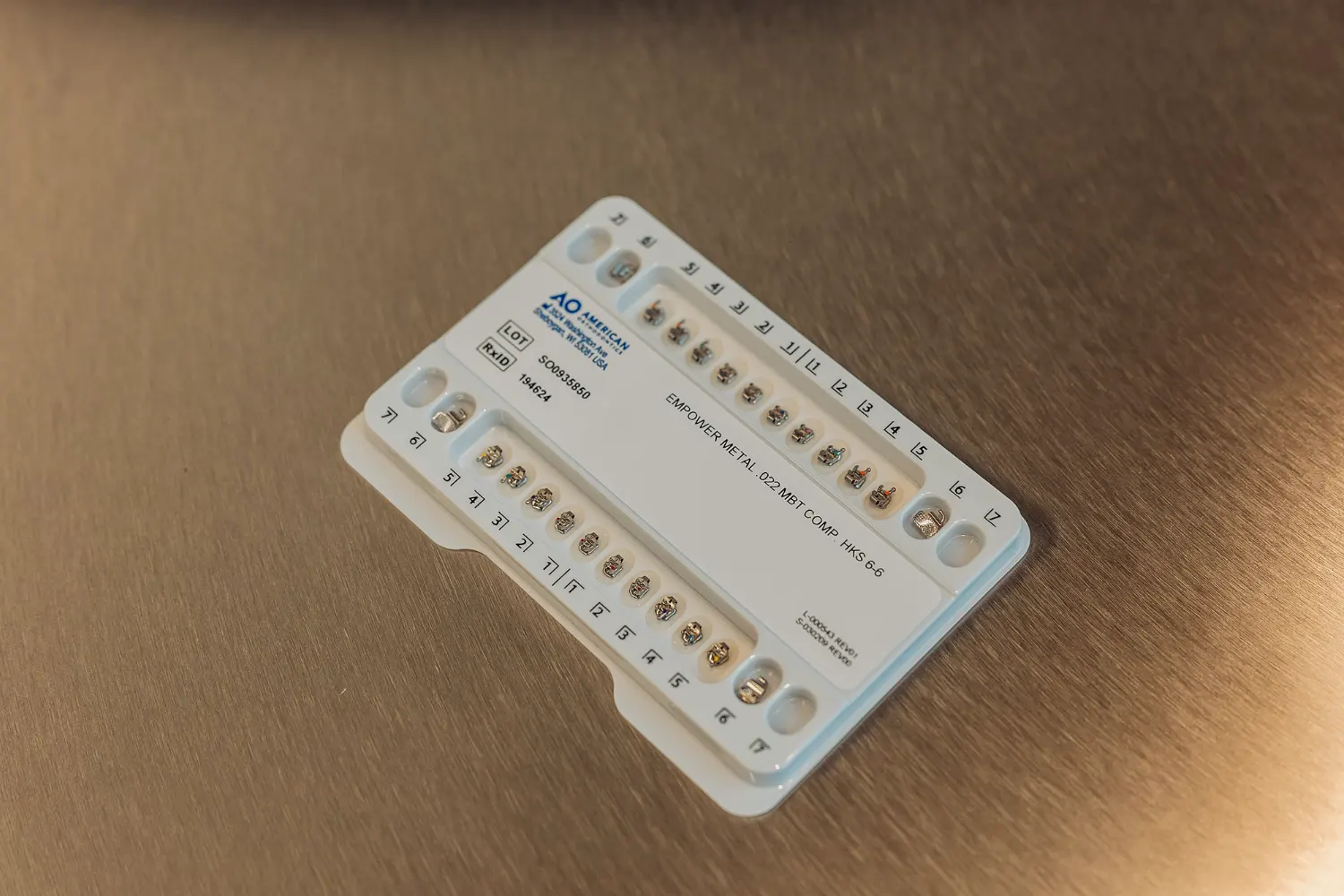
Active self-ligating brackets feature a built-in mechanism that holds the archwire in place without the need for additional elastic or metal ligatures. The treatment concept aims for controlled force transmission, simplified handling, and reduced ligature-related friction. Systems such as Empower from American Orthodontics conceptually belong to this group; however, reliable clinical conclusions can be drawn primarily from studies on active self-ligating brackets as a whole, rather than from high-quality, product-specific evidence regarding Empower alone. (Springer Link)
What do evidence-based studies show?
The key conclusion is this: Active self-ligating brackets are not superior in every respect, but they do offer measurable advantages in certain aspects. A systematic review with a meta-analysis based on randomized clinical trials found that active self-ligating brackets appear to be more efficient than passive self-ligating brackets in terms of initial alignment. In contrast, no clear advantage of any particular design was found with regard to changes in width. (Springer Link)
A systematic network meta-analysis comparing active self-ligating, passive self-ligating, and conventional brackets also concluded that, while most clinical variables do not differ significantly, individual differences can indeed be relevant. A practical efficiency advantage was particularly evident when ligating and unligating the archwire: According to the analyzed data, this process was 5 to 6 times faster with active self-ligating brackets than with conventional ceramic brackets. (ScienceDirect)
What are some legitimate benefits?
1. Efficiency in the early alignment phase
The best current evidence regarding active self-ligating brackets pertains to initial alignment. According to a meta-analysis, active systems may be more efficient than passive systems precisely during this phase. This is relevant in clinical practice because early leveling and alignment often constitute an important first step in treatment. (Springer Link)
2. Faster and easier handling at the dental chair
A clear practical advantage of self-ligating systems is the simplified handling of archwires. In the network meta-analysis, the process of ligating and unligating active self-ligating brackets was significantly faster than with conventional brackets. While this does not automatically prove that overall treatment time is shorter, it can make daily practice more efficient. (ScienceDirect)
3. Potential Benefits in Cases of Plaque Accumulation
The evidence regarding oral hygiene is limited, but not entirely negative. A 2022 meta-analysis found that self-ligating brackets offered a significant advantage in terms of the plaque index compared to conventional brackets, even though no significant differences were observed for the gingival index, probing depth, or bleeding on probing, and the authors did not conclude that self-ligating brackets were generally superior in terms of periodontal health. This suggests that self-ligating systems may be hygienically beneficial, at least in certain respects. (MDPI)
4. Favorable dental side effects in individual analyses
An umbrella review of systematic reviews on self-ligating brackets reported evidence of reduced lower incisor proclination and greater posterior transverse dimensions compared to conventional brackets in individual analyses. Such effects should not be interpreted as a general advantage of any treatment, but they do show that bracket-related differences can be clinically relevant in certain biomechanical situations. (Sage Journals)
What Should Be Classified Scientifically and Fairly
As important as the benefits may be, the current evidence does not show any clear overall superiority of active or self-ligating brackets in terms of total treatment duration, number of appointments, or pain during treatment. Several reviews and meta-analyses found no significant differences compared to conventional systems. (Springer Link)
That is precisely why clear communication is important: The benefits of active self-ligating brackets lie not in sweeping promises, but in specific advantages in terms of mechanics, handling, and individual treatment phases. (Springer Link)
What does this mean for patients?
For patients, the benefits can be summarized as follows: Active self-ligating brackets are a modern treatment concept that can support an efficient early phase of alignment, simplified clinical management, and potential hygiene benefits in certain aspects. However, the success of treatment continues to depend primarily on diagnosis, treatment planning, and individual biomechanics—not solely on the type of bracket. (Springer Link)
Conclusion
The current evidence-based literature shows that active self-ligating brackets have proven advantages, particularly in terms of initial alignment and clinical handling. In addition, there is evidence of beneficial effects on specific hygienic and biomechanical parameters. Although general superiority across all clinical endpoints has not been demonstrated, as a modern bracket system, active self-ligating systems can be a valuable component of efficient orthodontic treatment when used for the appropriate indications. (Springer Link)
Sources
- Yang X, et al. Differences between active and passive self-ligating brackets for orthodontic treatment: a systematic review and meta-analysis based on randomized clinical trials. Journal of Orofacial Orthopedics (2017). Active systems appeared to be more efficient during the initial alignment phase. (Springer Link)
- Maizeray R, et al. Is there any difference between conventional, passive, and active self-ligating brackets? A systematic review and network meta-analysis. International Orthodontics (2021). No difference was found for most variables; faster ligation and deligation with active self-ligating brackets. (ScienceDirect)
- Čelar A, et al. Systematic review of self-ligating vs. conventional brackets: initial pain, number of visits, treatment time. Journal of Orofacial Orthopedics (2013). No significant differences in pain, number of visits, or total treatment duration. (Springer Link)
- Mester A, et al. Periodontal Health in Patients with Self-Ligating Brackets: A Systematic Review of Clinical Studies. Journal of Clinical Medicine (2022). An advantage in terms of plaque index, but no overall superiority regarding periodontal health. (MDPI)
- Umbrella Review of Systematic Reviews With or Without Meta-Analysis Assessing Treatment Outcomes and Efficiency of Self-Ligating Brackets (2022). Evidence of reduced incisor proclination and increased posterior transverse dimensions in individual analyses. (Sage Journals)