

Lingual braces are placed on the back of the teeth. No one can see them from the outside, and you’ll feel them with your tongue on the very first day. Everything there is to know about this type of brace is contained in these two sentences.
As orthodontists in Munich, we rarely recommend lingual braces. They have a specific range of applications, and outside of that, there’s usually a simpler way to achieve the same result. However, when they’re the right fit, they’re irreplaceable: they’re the only fixed braces that no one can see from the front. The practice is located in Schwabing-West, between Josephsplatz and Kurfürstenplatz, and we hear the following seven questions there every week.
Table of Contents
- One in seven: Lisping with an internal brace
- Two out of seven: the tongue, and where it rubs
- Three out of seven: Eating with braces on the back of your teeth
- Four out of Seven: Kissing, and Why Being Inside Gives You an Advantage
- Five out of seven: what you can see of a lingual brace
- Six out of seven: Cleaning braces you can't see
- Seven out of seven: Pain from braces on the inside
- What Testimonials About Invisible Braces Don't Show
- When We Do Not Recommend Lingual Braces, and What Is a Good Alternative
- When lingual braces are the right fit: what Ortholoft has to offer
- Lingual Braces at an Orthodontist's Office in Munich: The Initial Consultation
- Frequently Asked Questions About Lingual Braces
One in seven: Lisping with an internal brace
Most people lisp at first. The terms “lingual braces” and “lisping” appear in nearly every search query about this type of braces, and the available data on the subject is more conclusive than the discussion in online forums might suggest.
When pronouncing the sounds S, Z, and Sch, the tip of the tongue touches the back of the upper front teeth. With lingual braces, this is where the brackets—the small plates that hold the archwire in place—are located. Even a difference of just a few millimeters is enough to make these sibilant sounds sound different. Speech difficulties with lingual braces are therefore not uncommon; in fact, they are normal during the first few days.
A questionnaire-based study involving 115 patients measured this. In the group with lingual braces, 91.7 percent reported speech difficulties, compared to 71.1 percent in the group with conventional braces. The difference is even more pronounced in terms of severity: 63.9 percent of the lingual group described their difficulty as moderate to severe, while in the conventional group, 57.9 percent reported no or only mild limitations.
This same research provides reassurance. A controlled comparative study involving 60 participants found a 56 percent reduction in symptoms after three months, and from that point on, the difference compared to conventional braces was no longer statistically significant. In practice, we estimate it takes one to two weeks before speech with the lingual technique becomes unnoticeable in everyday life. Anyone who wears lingual braces and speaks a lot is most likely to notice the difference when reading aloud.
Some patients continue to experience symptoms for a longer period. In the questionnaire-based study, 42.4 percent reported difficulty speaking for more than three months, and a review of quality of life during treatment indicates a persistent impact on speech despite adaptation. Anyone whose job depends on their voice should be aware of this figure before making a decision.

Two out of seven: the tongue, and where it rubs
With braces on the outside, the cheek and lip experience friction. With braces on the inside, the tongue takes on this role, and it is more sensitive.
A meta-analysis of six studies compared the symptoms. The overall level of pain is similarly high for both types of braces; it simply shifts—to the tongue with internal braces, and to the cheek and lip with external braces. The most common sites of irritation are the edge of the tongue and the tip of the tongue; a sore tongue is the most common reason for follow-up inquiries in the first few days of wearing lingual braces. In the comparative study with 60 participants, tongue irritation was 65 percent more severe in the lingual group.
"The lingual technique isn't suitable for everyone's tongue, and I make that clear before the decision is made, not after. If you have a small mouth and limited tongue space, I'll prescribe aligners for you, even if you actually wanted the lingual option."
Dominik Pfeil, D.D.S., specialist in orthodontics, owner of the ortholoft practice
There’s not much you need to do to soothe the sore spots: drink plenty of fluids, eat soft foods for the first few days, and leave the area alone instead of probing it with your tongue. If it remains sore for a longer period, we’ll take a look at it without you having to wait for a follow-up appointment. Ortholoft treats acute cases on the same day after you call to schedule an appointment.
Three out of seven: Eating with braces on the back of your teeth
The first few days are different from wearing external braces—and quite noticeably so.
The tongue sorts the food and pushes it to the back of the mouth for swallowing. The lingual braces are located precisely in this area, which is why this process must be adjusted. A review of 49 studies explicitly cites difficulty eating as a disadvantage of this type of braces, especially in the period immediately following placement.
A second point is often overlooked. The same review found that with lingual braces, there was more plaque and more gum inflammation on the inner surfaces of the front teeth. Ortholoft therefore seals the smooth tooth surfaces around the brackets with BracePaste for all patients; brushing instruction is provided at the time of placement, and four professional teeth cleanings per year are included in the treatment package. Cleaning is performed using an EMS device and an extra-fine powder; both dental hygienists are trained in this procedure.
Four out of Seven: Kissing, and Why Being Inside Gives You an Advantage
Of all fixed braces, the lingual brace is the simplest.
The brackets face the tongue. On the outside, the tooth remains as it was; there are no edges on the lip side, and the lip rests against a smooth surface. This is why the meta-analysis found that brackets on the outside cause more discomfort to the cheeks and lips than those on the inside.
We don't want to make any promises at this point. It takes time to get used to it, and what feels unfamiliar in the first few days is unfamiliar for both of us. Once you've gotten used to it, this question usually doesn't come up anymore.
Five out of seven: what you can see of a lingual brace
You can't see them from the front, and that's what sets them apart from any other fixed braces.
A comparative study highlights the difference compared to ceramic brackets. Seventy-two percent of patients with lingual brackets reported that the treatment did not affect their appearance. Among those with ceramic brackets on the front of their teeth, only four percent said the same. Ceramic brackets are tooth-colored, but they are placed on the front of the teeth, and the archwire remains visible.
For working professionals, this is the real reason for this design, and it’s the point at which an aesthetic set of braces must be distinguished from a discreet one. Anyone who works at Schwabinger Tor or in Maxvorstadt and stands in front of people three times a day isn’t just deciding on a set of braces—they’re deciding on how they’ll present themselves for the next eighteen months.
Still, it’s not invisible in the literal sense. You can’t see the lingual braces, but you can hear them in the first few days. For details on how the treatment works and the results it achieves, visit the page on lingual braces in Munich.
Six out of seven: Cleaning braces you can't see
To do this, you’ll need a mirror, more time, and different tools than usual.
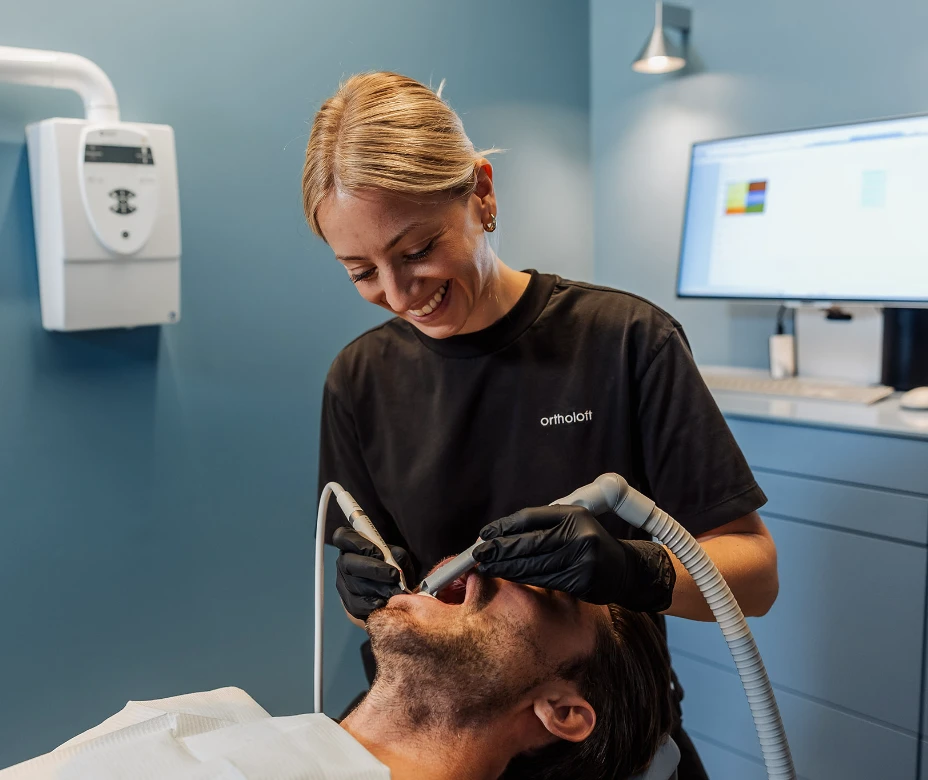
Lingual brackets are placed on the inside of the teeth and aren’t visible when you brush. You can only reach brackets behind your teeth by using a mirror. This makes oral care more time-consuming, but not more difficult. An interdental brush for the spaces between the brackets and gums, a water flosser for areas the brush can’t reach, and a hand mirror until you get the hang of the motion have proven to be effective.
At Ortholoft, the effects of fluoride treatment last six to nine months. Together with the sealants and four cleanings per year, this part of the treatment determines the condition of the teeth after the braces are removed.
Seven out of seven: Pain from braces on the inside
Not on the outside anymore, but somewhere else.
The meta-analysis found that the likelihood of experiencing any pain at all was the same for both types of braces. People who wear lingual braces feel them more often on their tongue and less often on their cheeks and lips. The review of 49 studies adds that discomfort begins slightly earlier with lingual braces and lasts longer. Pain associated with lingual braces is therefore not more severe, but is distributed differently over time, and this is one of the disadvantages of the lingual technique that should be considered before making a decision.
However, our practice procedures counteract this. We deliberately use low forces and change the archwire every six to eight weeks or more. The goal is to provide treatment that is as comfortable as possible, but we cannot guarantee it. If something is pressing on you in the evening or a wire is poking you, you can call to make an appointment and see us the same day.
What Testimonials About Invisible Braces Don't Show
There’s a lot written on forums and review sites about what it’s like to wear braces, and most of it applies to exactly one person. As orthodontists in Munich, we regularly go over these reports with our patients.
Three pieces of information are almost always missing: the diagnosis—that is, which malocclusion was treated; the system—since brackets vary considerably in height, and larger appliances have been shown to impair speech to a greater extent; and whether the case was even suitable for this type of appliance.
Before-and-after photos present the same problem in visual form. They show a result, not the condition itself, and not the path to that result. We do not publish such photos, for two reasons: The German Law on the Advertising of Medicines permits them only under strict conditions, and a pair of photos from someone else’s case does not apply to your situation.
"I can tell you what the research on the lingual technique shows, and I can show you what your scan reveals. What someone else has experienced in a forum is interesting, but it’s not a reliable basis for your decision."
Dominik Pfeil, D.D.S., specialist in orthodontics, owner of the ortholoft practice
Experiences with the lingual technique are useful in exactly one respect: they illustrate the range of outcomes. For some people, the adjustment period is over after just a few days; for others, it drags on for months. This same range is reflected in the studies, which is why case selection determines the outcome. So anyone looking for experiences with lingual braces will find, above all, a wide variation in results and rarely a comparable case.
When We Do Not Recommend Lingual Braces, and What Is a Good Alternative
Ortholoft uses the WIN system, which involves custom-made brackets on the inner surfaces of the teeth. This system is used to treat pronounced deep bites caused by skeletal factors—that is, those rooted in the bone rather than in the position of the individual teeth. When the teeth are closed, the incisors normally overlap by one to two millimeters. If this overlap is significantly greater and the masticatory muscles are particularly strong, the force provided by a clear aligner is insufficient. In these cases, lingual braces are the solution—not a compromise.
For all other findings, the results are different. The review of 49 studies concludes that lingual appliances achieve the same treatment goals as labial brackets, in the same amount of time and with even less loss of anchorage. The difference, then, lies not in the outcome but in the process—and that process is more taxing on the tongue. If a retainer or a set of braces on the outer surface produces the same result, it is the more obvious choice.
At Ortholoft, an orthodontic practice in Munich, two limitations are clear. For patients with small mouths and limited tongue space, we treat them with aligners. And we do not use a combination of aligners and the lingual technique—there has never been a case where this approach has ended well. This choice is not a criticism of the treatment method itself, but rather a prerequisite for its success. If an aligner can resolve the same issue, you’ll find information on how to proceed on the page about aligner treatment in Munich.
When lingual braces are the right fit: what Ortholoft has to offer
Lingual braces are very unforgiving. The brackets are custom-made for each tooth, and even a half-millimeter deviation in position alters how the archwire functions. Four factors therefore determine the outcome, and Ortholoft has all four covered.
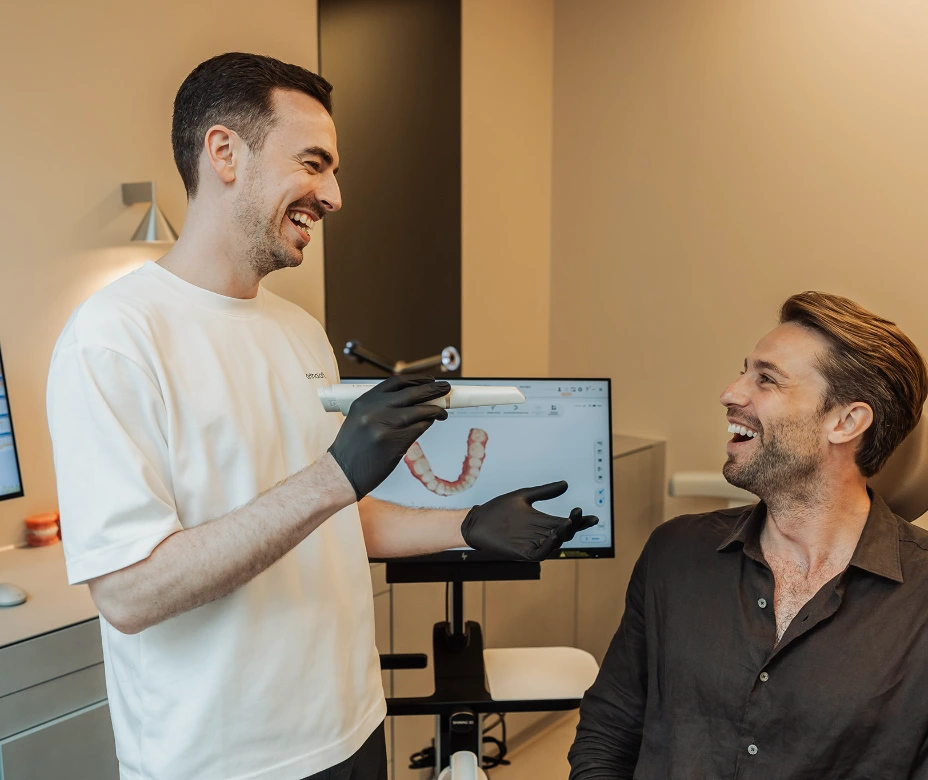
The process is digital. The intraoral scan takes about three minutes; we don’t use impression material in-house, and planning is done on-screen in OnyxCeph. For custom-made brackets, this isn’t a matter of convenience but a question of accuracy: What the scan doesn’t capture, the manufacturing process cannot compensate for. This manufacturing process is also the reason why lingual braces are more complex than conventional braces. Each bracket is custom-made for a single tooth, and follow-up appointments take longer because the archwire is less accessible on the inner side of the teeth. The implications for your specific case are outlined in the treatment and cost plan, which at ortholoft is always preceded by a summary written in plain language.
The system is set in stone. For lingual braces, Ortholoft works exclusively with WIN and does not switch systems on a case-by-case basis; this consistency brings routine to a technique that thrives on routine.
“With the lingual technique, the accuracy of the pre-treatment measurements determines the post-treatment outcome. That’s why I don’t use impressions or a rotating system—instead, I use a scan and a system I’m familiar with.”
Dominik Pfeil, D.D.S., specialist in orthodontics, owner of the ortholoft practice
The mechanics are secure. In cases of severe deep bite—the actual indication—we use mini-screws as the standard anchorage. The result then does not depend on how consistently the elastic bands are worn.
And the entire treatment is handled by a single provider, from bonding the brackets to the inner surfaces of your teeth all the way through to the retainer. Dr. Pfeil is a board-certified orthodontist and your sole treating dentist, so you’ll be seeing the same person throughout the entire process. At the end of every treatment with lingual braces comes the retention phase: fixed retainers are standard, along with one checkup per year and a two-year warranty on the retainers placed. All details regarding the process, systems, and costs can be found on the services page for lingual braces in Munich.
Lingual Braces at an Orthodontist's Office in Munich: The Initial Consultation
Whether lingual braces are an option for you depends on the results of your evaluation. Within 15 minutes, you’ll know if they’re right for you—and if not, what alternative treatment is best. The initial consultation is free for those with public health insurance and self-pay patients, and there’s no obligation. At ortholoft, orthodontic treatment for adults always begins with this appointment. It takes place in our private consultation room rather than at the treatment chair; the medical history is recorded digitally on an iPad, and you’ll be offered a cup of coffee before we discuss your teeth. The scan takes about three minutes; we do not use impression material in-house.
There are three appointments before treatment begins: initial consultation, treatment plan discussion, and treatment start. Ortholoft, an orthodontic practice in Munich, is located on the ground floor of a historic building with wheelchair-accessible entry. There is no on-site parking, but you can park your bike right outside the door. Appointments are available on three weekdays until 6:30 p.m. and one Saturday a month by appointment. Since follow-up visits are scheduled only every eight to ten weeks, it’s easy to plan your trip even from Neuhausen-Nymphenburg or northern Munich—for example, from Rotkreuzplatz or via the U2 from Scheidplatz. Orthodontics for adults in Munich makes up the majority of ortholoft’s practice, and braces for adults from Munich are the norm here, not the exception. Consultations and treatments are conducted in German and English.
Frequently Asked Questions About Lingual Braces
What are lingual braces?
Lingual braces are a type of fixed orthodontic appliance in which the brackets are placed on the back of the teeth, facing the tongue. Colloquially, they are referred to as “inner braces,” “braces on the inside,” or “braces on the tongue side”; in technical terms, they are known as lingual braces or the lingual technique. The mechanism is the same as that of braces on the outside: brackets hold an archwire, and the archwire moves the teeth. The differences lie in visibility and which tissues need to adapt.
Can you hear braces on the phone?
More so than in a face-to-face conversation, because the other person can’t see anything and can only hear. In the first few days, the “s” sounds are particularly noticeable. Anyone who talks on the phone a lot should plan for the first two weeks and avoid scheduling important calls for the day after the procedure.
Can I give presentations while wearing lingual braces?
Generally speaking, yes—but not during the first week without any preparation. Reading aloud is more helpful than remaining silent, because it helps the tongue find its new position more quickly. For some patients, speech remains noticeably altered for a longer period; in a questionnaire-based study spanning more than three months, this was the case for 42.4 percent of participants. Anyone who regularly performs on stage or participates in negotiations should openly discuss this during their consultation.
Does wax help with sore spots on the tongue?
Wax doesn't stick as well on the inside as it does on the outside because your tongue and saliva wear it away quickly. It's more effective to drink plenty of fluids, eat soft foods for the first few days, and be patient with the area. If it gets bigger or doesn't heal, we'll take a look at it.
Will the person I'm kissing notice my braces?
"Can you kiss while wearing braces?" is the question people usually ask, and the answer is yes. From the outside, nothing about the teeth has changed—there are no sharp edges or wires on the side facing the lips. That’s exactly why research shows that braces on the outside cause more discomfort to the lips and cheeks. Kissing while wearing braces is the easiest with the lingual (inside) type.
Can you see my braces when I smile?
Not when laughing normally. If you open your mouth wide, you can see the brackets on your lower jaw. So while they are “hidden” braces, they are not invisible in the literal sense. In a comparative study, 72 percent of wearers said the treatment had not affected their appearance; for ceramic brackets, that figure was four percent.
What supplies do I need for cleaning?
An interdental brush, a water flosser, and, during the initial phase, a hand mirror. Brackets on the inner surfaces of the front teeth tend to accumulate more plaque, as documented in review articles. For this reason, treatment at Ortholoft includes sealing the smooth tooth surfaces, brushing instruction at the time of placement, and four professional teeth cleanings per year.
What helps relieve the pressure during the first few days?
Soft foods, cool drinks, and avoiding hard crusts. The pressure comes from the archwire, not the brackets, and it subsides after two to three days. If you’re wondering whether braces on the back of the teeth hurt more than those on the front, the answer is: not overall, just in a different spot.
How long does treatment with lingual braces take?
Just as long as with braces on the outside. The review of 49 studies found the same treatment goals within the same time frame. The duration of treatment with lingual braces is therefore no different from that of conventional braces, and the duration of the lingual technique depends on the patient’s specific condition rather than the design of the appliance. At Ortholoft, treatment with fixed appliances typically lasts one and a half to two years, with checkups every eight to ten weeks. The checkup appointments themselves take a little longer because the archwire on the inner side is more difficult to access.
Can lingual braces be placed on just the lower jaw?
It is possible to use braces only on the lower teeth, but this only corrects problems limited to that area. As soon as the occlusion—that is, the way the teeth fit together when you bite down—is involved, braces on the lower teeth alone are not sufficient. This decision is based on the diagnosis, not on personal preference.
How much do lingual braces cost, and does health insurance cover them?
There is no flat rate here because the cost depends on the specific case: the number of teeth being moved, the fabrication of the brackets, and the duration of treatment. To put it in perspective: the lingual (inside) option is more complex than braces on the outside. For children and adolescents, the coverage provided by public health insurance plans is based on the KIG classification; the lingual technique is not covered under standard insurance benefits but is considered an additional service. For adults, insurance coverage is generally the exception and is limited to specific medical indications. The breakdown of what is covered by insurance and what is the patient’s out-of-pocket cost is specified in writing before the decision is made. Payment can be made in a single lump sum with a 3% discount or in installments over up to twenty-four months, interest-free and without a credit check. Details can be found on the “Costs” page of ortholoft.
Can I play a wind instrument while wearing lingual braces?
This is a situation we generally advise against. With wind instruments, the tongue and embouchure operate with precision down to a few millimeters, and fixed braces on the inside of the mouth alter precisely that space. The recommended solution in this case is treatment with aligners, because the aligners can be removed while playing.
Interior or exterior braces: Which is better for adults?
The decision is based on the diagnosis, not on appearance. Lingual braces for adults are the right choice if the diagnosis calls for them or if visibility is a real obstacle in your professional life. In all other cases, aligners or braces on the outside achieve the same result with less discomfort for the tongue. That’s why we only plan lingual braces for adults after the scan. Once the diagnosis is complete, we’ll let you know which of the two categories your case falls into.
Do orthodontists in Munich offer lingual braces?
Yes. Ortholoft, an orthodontic practice in Munich, uses the WIN system, which involves custom-made brackets on the inner surfaces of the teeth. If you’re looking for orthodontic care in Munich or an orthodontist for adults in Munich, you’ll find us in Schwabing-West. However, we don’t structure treatment as a one-size-fits-all solution, but rather as a response to a specific diagnosis. If you have a treatment plan and are unsure about it, we’ll review it and let you know what we would do the same and what we would do differently.
Schedule an initial consultation: 089 20001060 · Book an appointment online
Sources
- Questionnaire Study on Functional Limitations Associated with Labial and Lingual Orthodontic Appliances, 115 Patients Treated, BMC Oral Health, 2024
- Comparative Study on Patient Comfort and Treatment Efficiency: Lingual vs. Labial, 60 Patients Treated, 2025
- Meta-analysis of adverse effects of lingual and labial orthodontic appliances, six studies, 2013
- Systematic Review of Clinical Outcomes of the Lingual Technique, 49 Studies
- Systematic Review and Meta-Analysis of Oral Health-Related Quality of Life in Adults Undergoing Various Orthodontic Treatments
Reviewed by Dr. Dominik Pfeil, D.D.S., as of September 2026.
About the Author
