
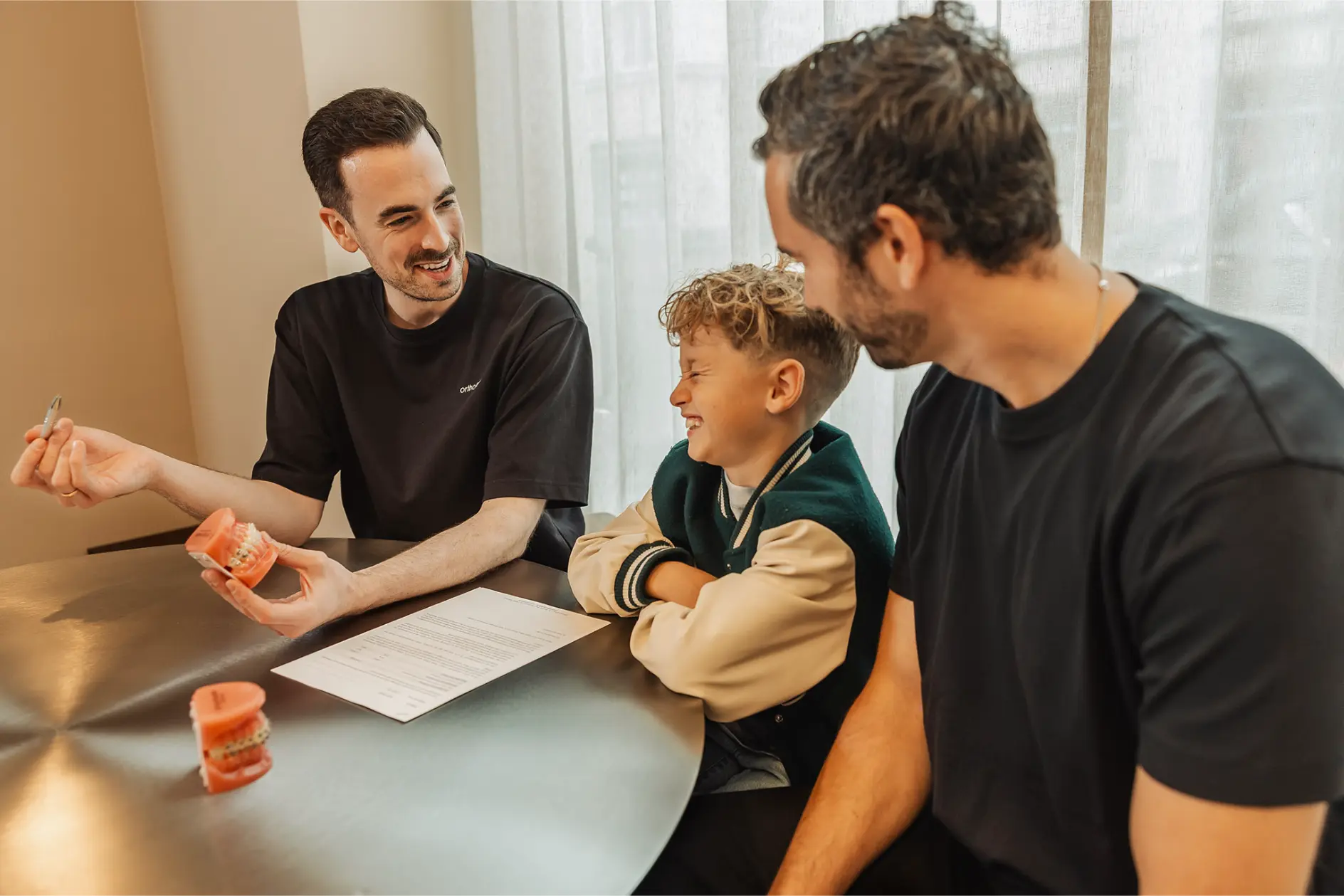
For most families, the question of orthodontic treatment doesn’t start with an orthodontist, but in the dentist’s chair at their family dentist’s office, between a checkup and scheduling the next appointment. There, a comment is made about a misaligned jaw, and on the way out, the questions that there wasn’t time to ask during the appointment are left behind.
This guide answers the eight questions parents ask most often: from the difference between dental and skeletal malocclusion to the mixed dentition stage and the KIG classification. The answer is the same for all eight: Orthodontic treatment for children is not a race.
Dr. Dominik Pfeil, D.D.S., an orthodontist in Munich, has overseen approximately 2,000 orthodontic treatments throughout his career and sees patients just a few minutes’ walk from Josephsplatz.
Table of Contents
- Question 1: Jaw misalignment or tooth misalignment, and what makes orthodontic treatment necessary
- Question 2: At what age does orthodontic treatment make sense?
- Question 3: What are the symptoms of permanent molars coming in?
- Question 4: Which conditions have a time window, and which orthodontic treatments can wait?
- Question 5: What Orthodontic Treatment Actually Does for a Child
- Question 6: Removable or fixed—which type of appliance is used for orthodontic treatment?
- Question 7: How long orthodontic treatment takes and how often you'll need to come in
- Question 8: KIG Classification—What the Health Insurance Plan Covers for Orthodontic Treatment
- Initial Consultation with an Orthodontist in Munich: The Three Appointments Leading Up to Treatment
- Frequently Asked Questions from Parents About Orthodontic Treatment
Question 1: Jaw misalignment or tooth misalignment, and what makes orthodontic treatment necessary
Two terms are regularly confused during parent-dentist consultations, and distinguishing between them is the first step. Malocclusion refers to the position of individual teeth. An incisor may be crooked, two teeth may overlap, or there may be a gap between them. Malocclusion of the jaws refers to the relationship between the two jaws—that is, the width, length, and position of the upper and lower jaws.
This difference determines the timing—and thus the entire course of orthodontic treatment. Teeth can be moved at any age, so correcting misaligned teeth alone is rarely urgent. A malocclusion, however, depends on growth, and growth doesn’t wait for an available appointment.
You can see part of it yourself—and you don’t need any special training to do so, just a mirror. Have your child take a slow bite. It’s important to do this slowly because the crucial part happens in the last millimeter. Then pay attention to three things: Do the gaps between the upper and lower incisors line up? Does the lower jaw slide to the side just before closing so that the rows of teeth meet? And how far do the upper incisors extend beyond the lower ones?
In everyday life, other things often stand out first. Children tend to chew on one side. Their lips don’t quite touch when at rest. The child has a harder time biting off food than before. These are clues, not diagnoses, and that’s exactly how they should be addressed in conversation.
In our practice, we systematically examine the same things—measuring rather than estimating—and without your child having to bite down on anything. We scan both rows of teeth with an intraoral scanner; this takes about three minutes, and we don’t even keep impression material on hand. The scan generates a digital model that allows for a direct comparison of the upper and lower jaws; this is analyzed using planning software that compares measured values to standard ranges. In addition, we take photos from the outside and inside the mouth using a dental iPad, because images reveal what actually happens when your child bites down.
There is a separate consultation room for children, because an 8-year-old tells her story differently than an adult. If you don’t notice anything at home, that doesn’t mean there isn’t a problem. A malocclusion in the posterior region is located far back and is barely visible from the front. A quick look in the bathroom doesn’t replace an examination; it simply helps explain what the issue is. Whether this leads to orthodontic treatment is determined after the initial consultation, not before.
Question 2: At what age does orthodontic treatment make sense?
The most common question parents ask is when it’s appropriate to consider fixed braces, and the second most common is whether it’s already too late. Both questions have the same answer: It’s not the child’s birthday that matters, but the diagnosis.
Dr. Pfeil, an orthodontist in Munich, sees children for the first time around age six. This isn’t a treatment appointment, but rather an evaluation: Is there an issue that needs to be addressed within a specific timeframe, or can we simply monitor the situation for now? The optimal time for orthodontic treatment is around age eleven, because by then most of the permanent teeth have come in and growth is still ongoing.
In between lies a question to which experts offer differing answers. Early treatment is almost always possible. Our approach is different: not sooner than necessary, and no braces without proven effectiveness. We only provide early treatment when clinical findings justify it—and not otherwise. A child who gets braces at age six—braces that would still have been effective at age eleven—has spent five years cooperating with the treatment and gained nothing.
“I’m often asked whether it’s better to start right away. For most cases, my answer is no. For a few, the answer is ‘right away,’ and in those cases, I make that clear. The difference lies in the diagnosis, not in the child’s age.”
Dominik Pfeil, D.D.S., specialist in orthodontics, owner of the ortholoft practice
This determines when fixed braces are needed. When do you need fixed braces? Generally, as soon as the permanent teeth have erupted far enough to accommodate brackets, usually between the ages of eleven and thirteen. When might you get fixed braces earlier? If a diagnosis calls for it and your dental condition allows it. There is no set age for getting fixed braces, and any number given to you without an examination is just a guess.
There’s no upper limit either. Teeth can still be moved even at age forty; it’s just that the treatment plan is different, and a significant portion of our orthodontic treatments are performed on adults. If you’re reading this for your child and thinking about your own teeth: It’s not too late—it just takes a different approach.
Before orthodontic treatment begins, you’ll see us three times: the initial consultation, a treatment plan discussion one to two weeks later, and the start of treatment. The initial consultation is free of charge for patients with public health insurance and those paying out of pocket. It lasts five to fifteen minutes, though we schedule half an hour so there’s plenty of time to answer your questions. If treatment is indicated, the initial diagnostic work will follow immediately, so you won’t need to come in a second time for scans and X-rays.
Question 3: What are the symptoms of permanent molars coming in?
The transition to permanent teeth begins around age six and lasts until about age twelve. During this time, something happens that many parents overlook because it occurs silently: the first permanent molars erupt behind the baby teeth without any teeth falling out first. So there’s no wobbling, no tooth fairy, and no reason to take a closer look.
Children usually describe the symptoms of permanent molar eruption in passing. The gum over the tooth is reddened and sensitive to pressure. They chew less on the affected side. Some children chew on the other side while eating or leave hard pieces uneaten. Less commonly, there may be additional symptoms that parents do not immediately recognize, such as restless sleep on the days when the tooth breaks through the gum.
For parents, the most important thing here is knowing how to interpret the situation. Symptoms associated with the eruption of permanent molars are not a diagnosis in and of themselves, but rather a sign that a tooth is coming in. From an orthodontic perspective, tooth eruption only becomes a concern if it fails to occur, if it proceeds in a clearly asymmetrical manner, or if the new tooth cannot find enough space.
Space is more important than appearance in this context, because it is more often the deciding factor in whether orthodontic treatment is needed. Baby teeth are smaller than their permanent counterparts. If a baby tooth is lost too early, the adjacent teeth drift into the gap, and the permanent tooth will later find that there is no room left for it. If an X-ray later shows that the tooth is erupting in the wrong direction, this is not a quirk of nature, but a consequence of this process.
That is exactly what we examine using images taken entirely in-house: a panoramic X-ray shows the position of all teeth, including their roots; a single-tooth X-ray provides detail on specific areas; and a digital lateral panoramic X-ray illustrates the relationship between the jaws. The images are evaluated using software—that is, by comparing measured values to standard ranges—rather than by visual estimation.
We also state what cannot be said with certainty. The order in which teeth erupt varies considerably among healthy children, and the severity of symptoms when the permanent molars erupt does not indicate how things will proceed. However, if a tooth erupts a year later than normal or fails to erupt on one side at all, this is a reason to schedule an appointment rather than wait and see. We treat clinical findings, not calendar dates.
Question 4: Which conditions have a time window, and which orthodontic treatments can wait?
There are few situations in which an early appointment is medically necessary, and many in which it serves no purpose. The most important distinction lies in the palatal suture. A suture runs down the center of the palate, dividing the upper jaw into two halves. In children, this suture is open; during puberty, it ossifies. As long as it remains open, an upper jaw that is too narrow can be widened along this suture. After that, treatment can still proceed, but with anchorage to the bone using mini-screws—a standard technique we use anyway, because they work regardless of the patient’s cooperation.
A crossbite is therefore a classic indication for starting orthodontic treatment earlier. We have a separate article on palatal expansion that covers the expansion process itself.
Other findings should be viewed with more perspective than they may seem online. An overbite in young children with their baby teeth is common and, in many cases, temporary, because a lot can still change as they lose their baby teeth and their lower jaw grows. An overbite in children with mixed dentition becomes a concern when the upper incisors protrude so far that the lip no longer covers them, or when the lower teeth strike the palate instead of the upper teeth. The same rule applies to an overbite in children as to any other finding: the millimeter measurement alone does not warrant orthodontic treatment; its consequences do.
In everyday practice, the difference looks like this: We note an overbite in young children and re-evaluate it at the next appointment. If an overbite is present in children in the late mixed dentition stage, we take measurements and develop a treatment plan, because that’s when the question of orthodontic treatment truly arises.
If the lower jaw is positioned too far back, this is the same finding when viewed from the other side. A lower jaw that is positioned too far back cannot be moved forward by tooth movement, but only through growth—and growth cannot be made up for later. This is why a lower jaw that is positioned too far back has a time window, whereas a twisted incisal edge does not.
This becomes evident during sports. If the lower jaw is positioned too far back, the upper incisors are exposed and are the first to be affected in the event of a fall. In such cases, we don’t wait years to begin orthodontic treatment. Conversely, if the lower jaw is positioned too far forward, we’re dealing with a different diagnosis and a different treatment plan; in severe cases, we collaborate with an oral surgery practice.
Crowded teeth during the mixed dentition phase are the most common reason parents come to us—and, at the same time, the one that is least urgent. Teeth are crowded either because the jaw is too small for them or because a tooth was lost too early. Both issues can be assessed as soon as the lateral incisors come in, and both can be addressed without the child needing braces at age seven.
There is one claim that is often made, but we deliberately avoid making it: that an untreated malocclusion inevitably leads to temporomandibular joint problems. While a connection is debated among experts, it is not an automatic consequence. We say this because the alternative would be to put pressure on parents with a prospect that we cannot substantiate. The findings alone are entirely sufficient for making a decision.
Question 5: What Orthodontic Treatment Actually Does for a Child
Orthodontic treatment is not cosmetic teeth straightening. It changes the positions of the teeth, and it does so using forces that must be gentle enough to allow the bone to adapt. Forces that are too strong do not move the teeth faster; they actually make the process more difficult.
That’s why we use five archwires throughout the entire orthodontic treatment: one round archwire and two edge archwires made of thermoelastic nickel-titanium, followed by two edge archwires made of steel. We change them at intervals of six to eight weeks or longer, deliberately applying low forces. The brackets are self-ligating, meaning they hold the archwire in place without rubber bands or wire ligatures. They are available in metal and ceramic, and we offer them at the same price. Still, about ninety percent of our teenage patients opt for metal—often with colored modules—because they see the color as part of the look.
Visible orthodontic treatment is only the final step in the process. Every orthodontic treatment begins with a digital model that defines the target position of the teeth before the first bracket is applied. Orthodontic treatment without this step would be a matter of trial and error.
The bonding process takes sixty to ninety minutes, and removing the braces at the end takes just as long. Before bonding, we seal the smooth surfaces of the teeth to protect the enamel around the brackets. Orthodontic treatment with fixed braces takes one and a half to two years, depending on the diagnosis. In Bavaria, this is often referred to in everyday speech as “braces” or “teeth straightening”—both terms mean the same thing.
The second part of orthodontic treatment for children has to do with brushing teeth and is often underestimated. Fixed braces create crevices where plaque can accumulate, and plaque in these areas leaves white spots that remain even after the braces are removed. That is why the treatment package includes brushing instruction at the start of treatment and four professional teeth cleanings per year, during which the archwire is removed and then reinserted. We clean the teeth using a particularly fine powder, and at the end of each session, we apply fluoride with a sustained-release effect lasting six to nine months.
Part of the consultation involves explaining what orthodontic treatment cannot do. It does not accelerate growth. It does not replace dental care. And it does not maintain results on its own. Orthodontic treatment that ends successfully only to start all over again after two years is not true orthodontic treatment. That is why the process does not end with the removal of braces, but with retention—and we’ll discuss that in Chapter 7.

Question 6: Removable or fixed—which type of appliance is used for orthodontic treatment?
Our answer here is more straightforward than parents often expect. A removable appliance is effective only as long as it is worn. This isn’t a criticism of children—it’s physics. It works for exactly as many hours as it is in the mouth, and an appliance that sits in a drawer means orthodontic treatment that isn’t progressing.
Added to this is the body of research, which is more limited for removable appliances than their reputation might suggest. We therefore routinely offer only one type of removable appliance: the Sander II appliance, because it is the only one with robust evidence of effectiveness. Other removable concepts that aim to correct misaligned teeth through muscle function or posture are not part of our offerings. Not because they sound exotic, but because we do not claim an effect that cannot be demonstrated.
For children, “fixed” doesn’t automatically mean braces. A cast palatal expander is fixed; it attaches to the back teeth and works without anyone having to think about it. It is fabricated based on a scan by a certified German specialty laboratory, supplemented by our own in-house 3D printing, which produces sixteen models in a single print run. Mini-screws also follow this principle: mechanisms that function independently of the patient’s actions. For orthodontic treatment that must withstand the demands of an 11-year-old’s daily life, this is often the more comfortable option.
Removable braces as a starting point for every child are therefore off the table, but the question of whether to use them remains. We use them when they make sense, and when fixed braces for children are the quicker option, we’ll say so. Choosing braces with brackets for children isn’t a decision against comfort, but one in favor of predictability. You can find more detailed information about which type of appliance is best suited for which dental condition on our service pages for fixed braces for children and removable braces.
"These days, you can straighten teeth with any modern orthodontic appliance. But they'll only stay straight if you have a plan."
Dominik Pfeil, D.D.S., specialist in orthodontics, owner of the ortholoft practice
Question 7: How long orthodontic treatment takes and how often you'll need to come in
The duration of orthodontic treatment is the one number parents want to hear—and the one that can’t be generalized. How long a child must wear braces depends on the diagnosis, the age at the start of treatment, and whether or not removable appliances are used. For fixed braces, the typical range is one and a half to two years. The specific duration for wearing fixed braces in each individual case is outlined in the treatment plan, and further details regarding wear time can be found in our guide on treatment duration.
The schedule, on the other hand, is predictable. Follow-up appointments are scheduled every six to ten weeks, are brief, and are set right then and there as you leave the office, so no one has to call twice. For short appointments and for siblings, there’s a room with two treatment stations, so two children can be seen in a single appointment. You’ll usually wait five to ten minutes in the waiting area. For checkups, you’ll always see the same orthodontist, Dr. Dominik Pfeil, an orthodontist in Munich, rather than a rotating team. Over the course of two years of orthodontic treatment, that matters more than any detail in the waiting room.
Because the checkpoints are spread out like this, the route is manageable even from a greater distance. Appointments are available until 6:30 p.m. and, one Saturday a month, by appointment; for families from Schwabing and Leopoldstraße, this means one afternoon appointment every two months. For students at Gisela-Gymnasium, the clinic is on their way home; older teens usually come to their final checkups on their own.
Retention is the final step, and it is the true focus of this practice. Teeth have a “memory,” which is why we use fixed retainers as standard—digitally planned and bent. We offer a two-year warranty on the retainers we place, with checkups once a year. If there is a high risk of relapse, a removable retainer is also provided. Orthodontic treatment, therefore, does not end with straight teeth, but with a plan to keep them straight.

Question 8: KIG Classification—What the Health Insurance Plan Covers for Orthodontic Treatment
Whether statutory health insurance covers orthodontic treatment is not determined by the practice or the insurance provider on a case-by-case basis, but rather by the KIG classification. KIG stands for “orthodontic indication groups”; classification is based on the severity of the condition, measured in millimeters, and tooth positions. We will let you know which group your child falls into before treatment begins, not afterward.
If orthodontic treatment is covered, the insurance benefits cover the necessary care. The insurance-covered model for fixed braces involves metal brackets, and our insurance-covered brackets use the same self-ligating technique and the same archwire sequence as all others. If you prefer ceramic brackets, there is no additional charge at our practice. This decision is made by the practice, not the health insurance provider. The same applies to the standard fixed braces option: Fixed braces covered by insurance are not an inferior treatment—they are simply provided at no extra cost.
In addition, there are services that go beyond what is covered by insurance. Which of these make sense in your case—and which do not—is something best discussed in person rather than listed here. Before any treatment or cost plan is finalized, you’ll receive a summary written in plain language so that you know what you’re signing before you sign it.
Details on how the patient copay, additional services, and payment methods are broken down can be found on our costs page, which also includes information on payment plans. As a general rule, the practice is contracted with health insurance providers and treats patients with public and private insurance as well as self-pay patients.
Initial Consultation with an Orthodontist in Munich: The Three Appointments Leading Up to Treatment
You don't need to make any decisions based on this text. The next logical step is an evaluation, which is free of charge for those with public health insurance and for self-pay patients.
During the initial consultation, the assistant will first discuss your concerns with you so that the orthodontist is informed when they enter the room and you don’t have to repeat yourself. Afterward, you’ll know whether there are any findings, whether they’re urgent, and whether orthodontic treatment is necessary. If treatment is indicated, the initial diagnostic evaluation will follow immediately afterward, the treatment plan discussion will take place in one to two weeks, and then treatment will begin.
What many parents in Munich-Schwabing refer to as “pediatric orthopedics” is technically known as orthodontic treatment for children and adolescents. And it should fit into a family’s daily routine—not the other way around.
Sie erreichen uns unter 089 20001060 oder online über die Terminbuchung. Die Praxis liegt in der Nordendstraße 56 in Schwabing-West, im Erdgeschoss eines Altbaus, barrierefrei über einen ebenerdigen Zugang. Mit der Tram 28 halten Sie direkt vor dem Haus, die Haltestelle trägt denselben Namen wie die Straße, und Fahrradständer gibt es unmittelbar davor. Praxiseigene Parkplätze haben wir nicht, im Umfeld gibt es ausschließlich gebührenpflichtige Straßenparkplätze, deshalb kommen die meisten Familien mit der Tram oder mit dem Rad.
Frequently Asked Questions from Parents About Orthodontic Treatment
At what age should a child start seeing an orthodontist?
The first visit takes place around age six, and this is explicitly not a treatment appointment. The purpose is to determine whether there is a condition for which timing is critical. The main treatment period begins around age eleven. It’s not possible to determine from this when fixed braces will be needed, because the permanent teeth must have erupted far enough for that. There is no fixed age limit in either direction: tooth movement is possible at any age; only the treatment plan differs.
How can I tell if my child has a misaligned jaw?
Every orthodontic treatment begins with an evaluation. There are three signs you can check for at home: whether the midlines of the upper and lower incisors align, whether the lower jaw shifts to one side when closing the mouth, and how far the upper teeth protrude over the lower ones. In addition, there are everyday observations such as chewing on one side. These are signs of a malocclusion, not a diagnosis. Misalignment of individual teeth, on the other hand, is usually noticeable right away, but from a professional standpoint, it is often the less serious of the two.
What are the symptoms associated with the eruption of permanent molars?
Red, tender gums over the erupting tooth, reduced chewing on the affected side, and occasionally restless sleep during the days of eruption. Because the first permanent molars erupt behind the baby teeth, no tooth falls out during this process, which is why parents often do not notice it. Symptoms associated with the eruption of permanent molars are normal and, in and of themselves, do not warrant orthodontic treatment. However, a tooth that fails to erupt or erupts on only one side does warrant such treatment.
When do you get fixed braces?
Once enough permanent teeth have erupted to accommodate brackets, usually between the ages of eleven and thirteen. Whether a patient receives fixed braces earlier depends on the diagnosis: In cases where there is a time window, we start treatment earlier, but often begin with a fixed appliance that does not consist of brackets. Is there an age limit for getting fixed braces? There is no such limit; we also treat adults.
Do I need treatment if my teeth are only slightly crooked?
Not necessarily. A mild misalignment of the teeth with no functional consequences is a condition that can be monitored, and orthodontic treatment is then a choice rather than a necessity. The situation is different if teeth are wearing each other down, if a tooth cannot find enough space to erupt, or if the bite is misaligned. We’ll let you know which of these two situations applies to you, even if the answer is: do nothing for now.
Does an overbite in a child go away on its own?
An overbite in young children with primary teeth often corrects itself as the lower jaw catches up as it grows. In contrast, an overbite in children with mixed dentition rarely resolves on its own, especially if the lower jaw is positioned too far back and the cause is therefore related to the proportions of the jaws. The decisive factor is not how far the upper teeth protrude, but whether the lip still covers them and where the lower teeth make contact.
How long does orthodontic treatment take for children?
Orthodontic treatment with fixed braces takes one and a half to two years, followed by the retention phase. How long a child must wear braces depends heavily on the diagnosis, and there is no single figure that applies to every child. The duration of fixed braces treatment in each individual case is therefore specified in the treatment plan, which you will receive before treatment begins. Follow-up appointments are scheduled every six to ten weeks during this time.
What does health insurance cover, and what does it depend on?
Based on the KIG classification—that is, the severity of the diagnosis. If the classification qualifies for coverage under the health insurance plan, the necessary treatment will be covered. The insurance plan covers metal brackets, and our insurance-covered brackets use the same self-ligating technology as all our other brackets. We do not charge extra for ceramic brackets. We’ll discuss any treatment that goes beyond what’s covered by insurance for fixed braces in advance, along with a summary of the treatment and cost plan written in plain language.
My child wants braces, even though there is no medical indication for them
Before orthodontic treatment, we hear this request more often than you might think. For 11- or 12-year-olds, the phrase “I want braces” is sometimes more of a desire to fit in than a concern about their teeth. We take it seriously nonetheless and answer the question “Do I need braces?” not based on personal preference, but on the findings of an examination. If no orthodontic treatment is indicated, we tell the child directly—not through the parents. And if orthodontic treatment does become necessary later on, the child will remember that they were heard.
What colors are available, and do boys choose different braces than girls?
Medically speaking, there is no difference, neither in the appliances nor in the treatment plan. When it comes to appearance, preferences do vary in everyday life—though less so between boys and girls than between age groups. About ninety percent of our teenage patients choose metal braces, many of them with colored modules that can be changed at each follow-up appointment. Ceramic braces are the more discreet option and cost no more at our practice.
Since when have fixed braces been around?
Fixed braces in their current basic form have been around since the early 20th century; bonded brackets are much more recent and did not become widespread until the 1970s. However, when fixed braces first appeared is less important for your child than the question of what has changed since then: Today, the archwires apply small, even forces over the course of weeks, and orthodontic treatment is planned using a digital model rather than a plaster cast.
Can we switch orthodontists in the middle of treatment?
Yes, it’s possible to switch orthodontists, and this happens regularly when people move. Please bring whatever you have with you: your treatment plan, X-rays, and details about your treatment so far. We’ll assess your current progress, take new scans, and explain how we would proceed with your orthodontic treatment, as well as what that means in terms of duration and billing. We also handle retainer emergencies for patients from other practices; you don’t need to be currently undergoing treatment with us for this.
How do I find an orthodontist for children in Munich?
Pay attention to the title: “Specialist in Orthodontics” indicates several years of additional training after medical school, and only those who have completed this training are permitted to use this title. Dr. Dominik Pfeil, an orthodontist in Munich, has held this title since 2021. Also, ask who will be providing treatment and how often the treating dentist changes, because continuity in orthodontic treatment lasting over two years isn’t just a matter of convenience—it’s a matter of quality. If you’re looking for pediatric orthodontics in northern Munich: Dr. Pfeil is a pediatric orthodontist in Munich-Schwabing; pediatric orthodontics in Munich-Schwabing is one of the practice’s areas of specialization, and we are accepting new patients.
Is it worth the trip if we don't live in Schwabing?
That depends less on distance than on the frequency of appointments. Since orthodontic treatment requires checkups only every six to ten weeks, the practice is easily accessible from Neuhausen, northern Munich, or from beyond the Mittlerer Ring. Two siblings can be treated during a single appointment, and appointment times available until 6:30 p.m. as well as one Saturday a month make it easy to fit a visit into your daily routine. For families in the neighborhood, the practice is located between Elisabethplatz and Luitpoldpark; for everyone else, it’s on the tram route toward downtown.
Reviewed by Dr. Dominik Pfeil, D.D.S., as of September 2026.
About the Author
