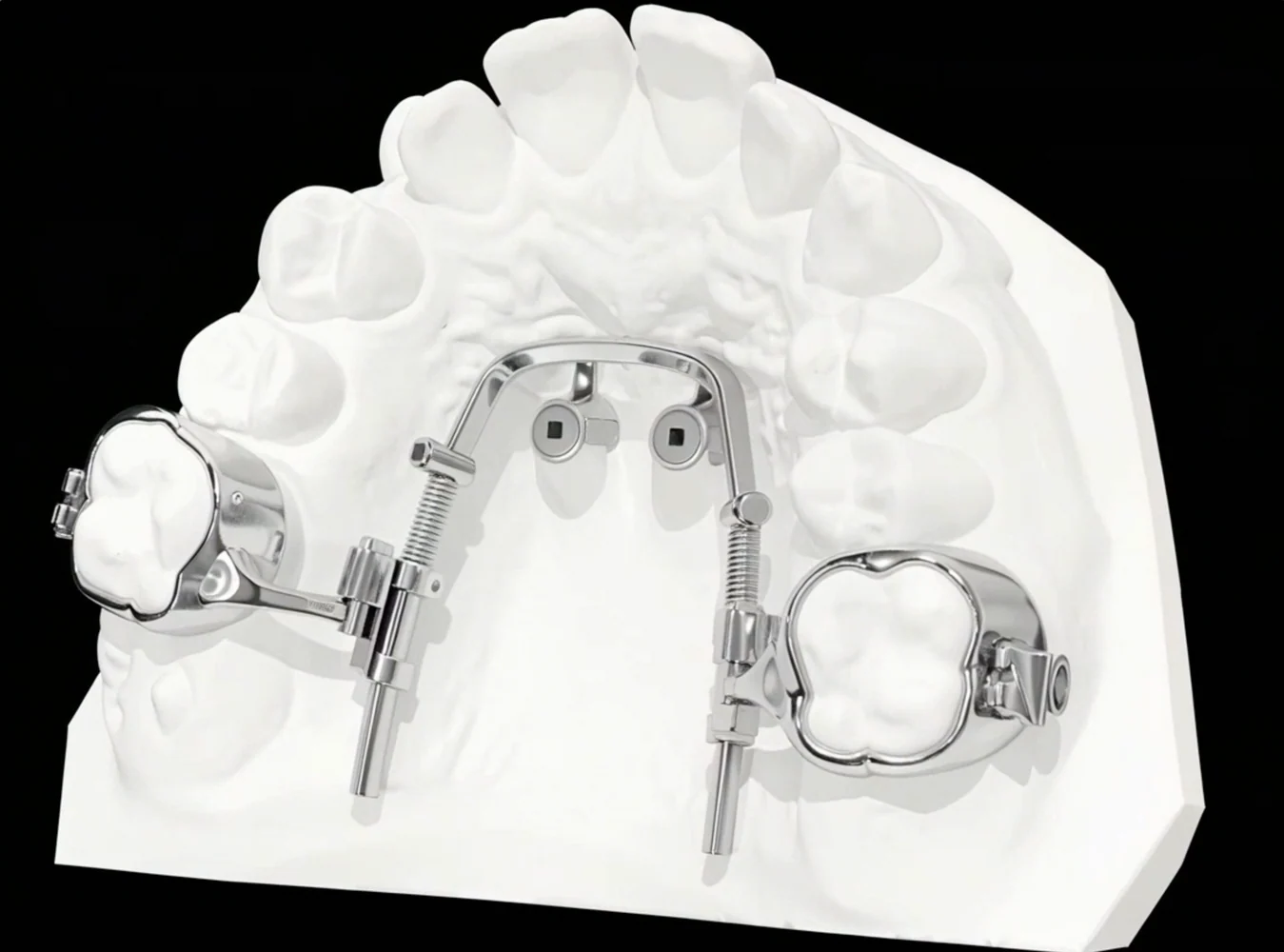
Mini-Screws in Orthodontics: The Clinical Benefits of Distal and Mesial Sliders
Mini-screws (TADs, Temporary Anchorage Devices) have significantly expanded the field of orthodontics. Their key advantage is that tooth movements can be performed with skeletal anchorage—meaning there is significantly less unwanted counter-movement of other teeth. This is precisely what makes concepts such as the distal slider/Benes slider and mesial slider so clinically interesting. The most recent evidence highlights advantages particularly in terms of anchorage control, predictable molar movement, and reduced reliance on patient compliance. (ScienceDirect)
Why Mini Screws Are So Valuable Clinically
The major difference from purely tooth-supported mechanisms lies in the anchorage: Reactive forces no longer need to be absorbed primarily by other teeth. This allows for more precise movement control, while reducing undesirable side effects such as mesial movement of premolars or labial proclination of the anterior teeth. It is precisely this advantage that is repeatedly highlighted in the current literature on skeletally anchored distalization mechanisms. (ScienceDirect)
Distal Slider: Advantages in Molar Distalization
The evidence is strongest for the distalization of maxillary molars. A recent systematic review on the effectiveness of orthodontic mini-screws for molar distalization describes TAD-assisted distalization as an effective method and highlights its clinical benefits compared to conventional anchorage. (ScienceDirect)
Palatal anchorage is particularly relevant. A systematic review of maxillary molar distalization using TADs showed that palatally anchored systems allow for greater distalization movements with good control while limiting the typical side effects of conventional distalization appliances. (angle-orthodontist.kglmeridian.com)
In practice, this means that distal slider systems are particularly attractive when the goal is non-extraction Class II correction, space creation, or distalization without the need for headgear compliance. The literature on total maxillary arch distalization with TADs describes such approaches as effective and stable, but also notes that high-quality prospective studies are still needed. (ScienceDirect)
A clear advantage: fewer unwanted side effects
A biomechanical advantage of palatal miniscrews is better control of tooth movement. An analysis of miniscrew-assisted distalization showed that direct palatal anchorage, in particular, may be associated with greater distalization, less mesial movement of the premolars, and less labial tilting of the anterior teeth. This is clinically relevant because these very side effects often limit the effectiveness of conventional distalization mechanisms. (OUP Academic)
Mesial Slider: Useful for Closing Gaps and Asymmetrical Situations
The evidence supporting the mesial slider is less extensive than that for distalization systems, but it is certainly of clinical interest. The principle is particularly useful when the upper jaw needs to be moved mesially, such as when closing gaps after tooth loss, in cases of agenesis, or in asymmetrical dental arches. Case series and recent clinical studies show that such movements can be performed in a controlled manner using palatal mini-screw anchorage. (ScienceDirect)
A recent retrospective study on the mesial-distal slider for maxillary midline deviations showed that asymmetric molar movements were possible without clinically relevant loss of anchorage. In this cohort, an average of 4.5 ± 2.2 mm of anteroposterior molar movement was achieved on the mesialization side and 2.4 ± 1.7 mm on the distalization side; the authors also emphasize that no patient compliance was required. (MDPI)
When Slider Systems Are Particularly Advantageous
From a strictly scientific standpoint, it can be said that distal and mesial sliders offer clinical advantages primarily in the following situations:
- when strong anchoring is required,
- if patient-independent mechanisms are desired,
- if side effects in the front or premolar regions are to be minimized as much as possible,
- and when unilateral or asymmetrical tooth movements are planned. (ScienceDirect)
Another practical advantage, particularly with palatal TADs, is that the mini-screws are located outside the tooth roots and are therefore less likely to be “in the way” during major tooth movements than screws placed interradicularly. (angle-orthodontist.kglmeridian.com)
Scientifically and fairly classified
The body of evidence supporting TAD-assisted distalization is generally strong, though it varies in strength depending on the specific slider system. Systematic reviews and several clinical studies exist for distal sliders and Benes sliders; for mesial sliders and combined asymmetric slider systems, the evidence is based more heavily on retrospective studies and case series. Therefore, the benefits should be described in positive terms, but without exaggeration. (ScienceDirect)
Conclusion
From an evidence-based perspective, mini-screws are a highly valuable component of modern orthodontics. Distal sliders, in particular, offer advantages in controlled molar distalization, the reduction of undesirable side effects, and independent anchorage without active patient cooperation. Mesial sliders are clinically useful, particularly for closing gaps, treating asymmetrical cases, and managing complex anchorage. Overall, studies show that skeletally anchored slider mechanisms can make tooth movements more precise, more predictable, and often less dependent on patient compliance. (ScienceDirect)
Sources
- Effectiveness of Orthodontic Mini-Screws for Molar Distalization. Systematic Review, 2025. (ScienceDirect)
- Systematic review and meta-analysis of total maxillary dental arch distalization using TADs. Conclusion: effective and stable, but more prospective studies are needed. (ScienceDirect)
- Effectiveness of Miniscrew-Supported Maxillary Molar Distalization According to TAD Location and Appliance Design. Systematic Review, 2024. (angle-orthodontist.kglmeridian.com)
- Biomechanical analysis of miniscrew-assisted molar distalization. Advantages of direct palatal anchorage: greater distalization, less mesial premolar movement, less anterior tooth proclination. (OUP Academic)
- Upper Midline Correction Using the Mesial-Distal Slider. Retrospective Clinical Study, 2024. (MDPI)