

There are several ways to get straight teeth. Seven of these are commonly considered for adults, and most people are familiar with two: braces and clear aligners. None of the seven options costs only money: aligners require 22 hours of wear per day; visible braces take one and a half to two years; it takes two weeks to get used to the sensation on your tongue; or a few weeks with an appliance on the roof of your mouth if your jaw is too narrow. The seven options differ less in the technology involved than in what they require of you.
Your diagnosis will then determine which treatment option for straight teeth is right for you. And that comes down to a single question: what type of tooth movement is necessary. Almost any procedure can tilt a tooth. However, moving a root or rotating a tooth around its own axis is not. As orthodontists in Munich—located on Nordendstraße near Tengstraße—we see all seven methods every day, some of them much more frequently than others.
Table of Contents
- Option 1 of 7: Straight front teeth only; aligners from canine to canine
- Option 2 of 7: Dental aligners ordered online without an examination
- Method 3 of 7: Straight teeth with aligners for all teeth, worn 22 hours a day
- Method 4 of 7: Straight teeth with fixed braces and brackets, one and a half to two years
- Method 5 of 7: Straight Teeth with Lingual Braces Behind the Teeth
- Method 6 of 7: Straight Teeth Through More Space—Palatal Expander Treatment
- Method 7 of 7: Mini Screws—the method that doesn't depend on your cooperation
- Straightening Teeth: What Treatment Plan Is Right for You?
- Straight Teeth Without Treatment: When It's Better to Wait Than to Get Braces
- Keeping Your Teeth Straight: Why the Retainer Is Key to the Final Result
- Orthodontists in Munich: Which Path to Straight Teeth Is Right for You?
- Orthodontics: Frequently Asked Questions for Orthodontists in Munich
Option 1 of 7: Straight front teeth only; aligners from canine to canine
The quickest way to straight teeth is to move exactly the six teeth that are visible.
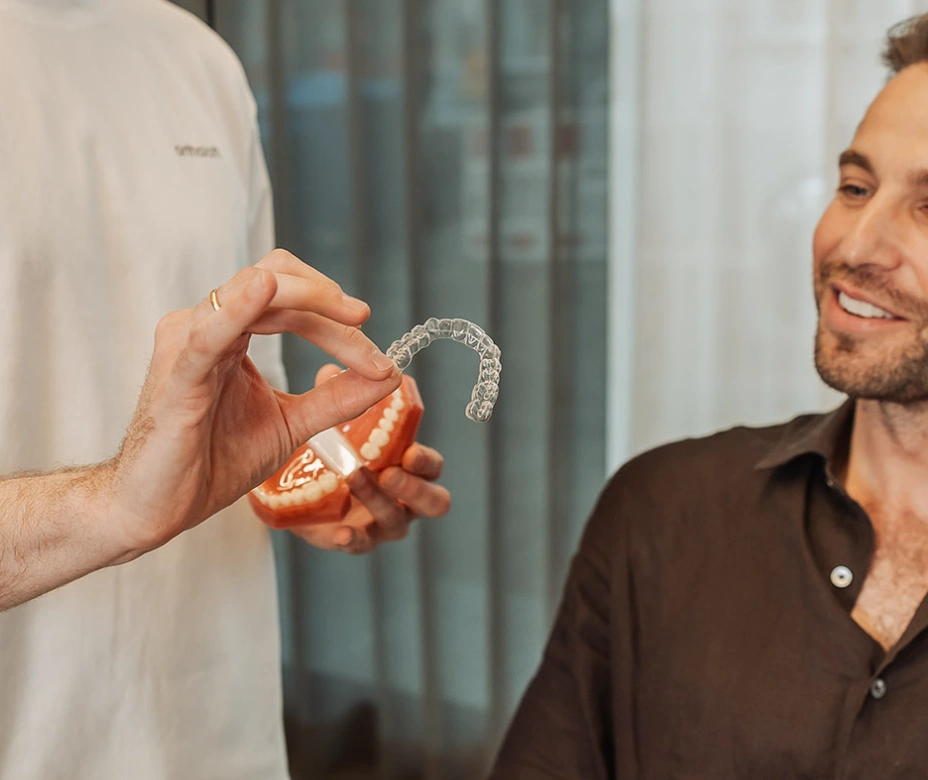
A three-to-three front tooth correction extends from canine to canine and leaves the back teeth in place. For those who want straight teeth—especially in the visible front—this is the shortest path to achieving that goal. We manufacture the aligners for this in-house using 3D printing, without going through a third-party laboratory. Our in-house Formlabs printer is capable of large-format printing and can produce sixteen models per print run. This approach is also effective when teeth have shifted back after a previous treatment, such as following a broken retainer. In technical terms, this relapse is called a recurrence.
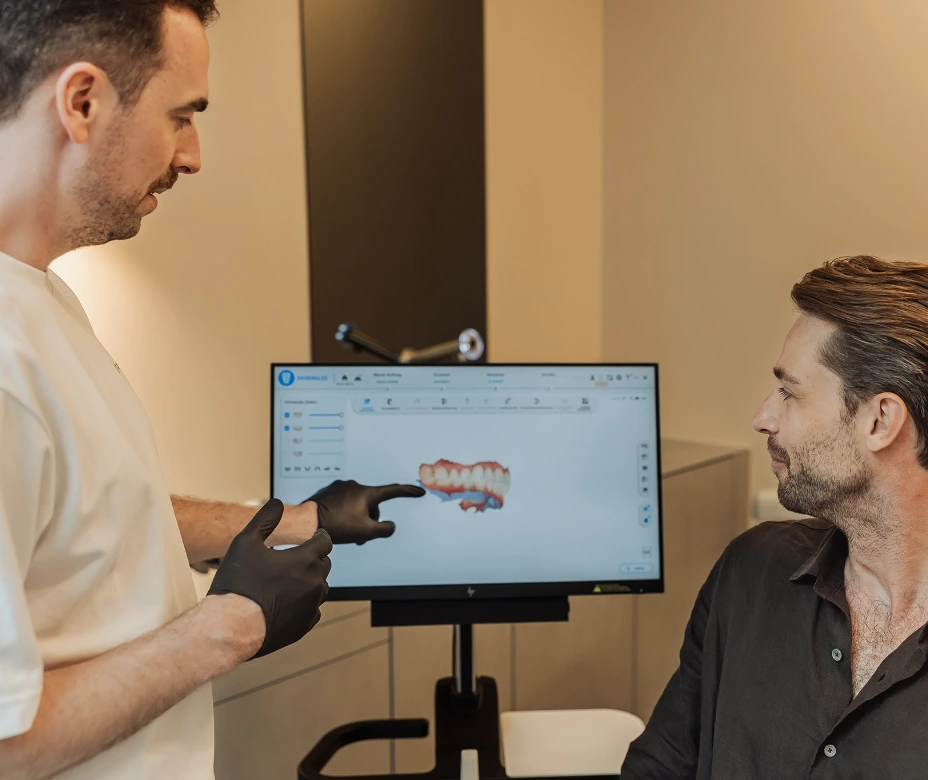
Its limitation lies where the cause lies. It corrects the position of the front teeth, not the occlusion behind them—that is, not the way the teeth fit together when you bite down. If the bite caused the crowding, the crowding will return, and the straight teeth will only last for a while. That’s why we start with the scan rather than the aligner: An intraoral scan with the Aoralscan takes about three minutes, after which we analyze the model digitally in OnyxCeph. We don’t need impression material for this—we don’t even have any on hand.
What this approach requires of you is a willingness to set aside the smaller solution if the diagnosis calls for the larger one. You can find out how aligner treatment works and what dental issues it addresses on the page about aligner treatment in Munich.
Option 2 of 7: Dental aligners ordered online without an examination
There are providers who send aligners by mail. Your case is assessed based on photos or an impression you take yourself; there is no in-person examination. Anyone looking for straight teeth without braces will end up here first, and the aligners do, in fact, move your teeth. The mechanism isn’t fundamentally different from that used in a dentist’s office. What’s missing is everything that happens before and after.
Three factors determine how far and how quickly a tooth can be moved: the position of the root, the amount of available bone, and the condition of the periodontal tissues—that is, the gums, periodontal ligament, and bone surrounding the tooth. None of these three factors can be seen in a photograph. At ortholoft, an orthodontic practice in Munich, initial diagnostics are therefore performed before any aligner treatment begins: a lateral X-ray, a panoramic X-ray of both jaws, and photographs of the teeth. On the screen, we measure the angles and distances between the jaw, the base of the skull, and the teeth; only then can we determine what kind of movement is even feasible. This process includes checkups every six to ten weeks, the retainer fitted at the end of treatment, and follow-up care afterward. Straight teeth can be achieved this way, but no one knows in advance what the cost will be for the roots.
What this path requires of you is trust without evidence.
Method 3 of 7: Straight teeth with aligners for all teeth, worn 22 hours a day
An aligner for the entire dental arch can do everything the front-tooth version can do—and much more. But it also demands more: The discreet version is the more challenging one, and it’s a challenge every single day.
An aligner only works as long as it is in your mouth. The recommended wear time is 22 hours a day; you should remove the aligner to eat, drink anything other than water, and brush your teeth. We work exclusively with SPARK by Ormco and hold the highest user status with them. Aligners are replaced every ten days; treatment lasts an average of about twelve months, and checkups take place every eight to ten weeks. In the year leading up to opening his practice, Dr. Pfeil managed approximately 130 ongoing aligner cases. In everyday life, clear aligners are barely visible, and they are not a substitute for a dental evaluation.
An aligner alone wouldn't have enough force to move a tooth. The tooth's surface area must be increased so that the aligner can grip the tooth. To do this, we bond attachments to the teeth and remove a small amount of enamel in specific areas. For working adults, this is the method that fits most discreetly into their daily routine, and at ortholoft in Schwabing-West, it's the most common choice.
“During the planning meeting, we go through the simulation together on the screen, and I show exactly where I’m reducing enamel and where an attachment is located. Anyone who’s seen this beforehand won’t be surprised later on. For me, the simulation is a tool for education, not a sales tool.”
Dominik Pfeil, D.D.S., specialist in orthodontics, owner of the ortholoft practice
There are two clear limitations: We do not use aligners to treat patients with extensive crowns or bridges because the aligners do not provide sufficient support in those areas. And we only treat adolescents with aligners at the express request of their parents, because patient compliance at that age is too unreliable.
This method helps you achieve straight teeth through your consistency. The choice between aligners and braces isn't a matter of comfort versus comfort. It's a matter of commitment versus visibility.
Method 4 of 7: Straight teeth with fixed braces and brackets, one and a half to two years
At Ortholoft, ceramic costs the same as metal. For adults, that's often the deciding factor.
Fixed braces work without you having to think about them because they are not removable. However, they are visible throughout the entire treatment period, which lasts one and a half to two years. We bond self-ligating Empower brackets from American Orthodontics, available in metal or ceramic, with no price difference between the two. The treatment involves five archwires: one round archwire and two edge archwires made of thermoelastic nickel-titanium, followed by two edge archwires made of steel. The archwires are changed every six to eight weeks or more, deliberately using low forces. Bonding and removal each take sixty to ninety minutes.
There are movements that braces can perform more reliably than any aligner: moving a root, rotating a tooth around its own axis, and closing an extraction gap—that is, a gap left after a tooth is extracted. When any of these movements is necessary, straight teeth cannot be achieved with aligners alone. This does, however, make oral hygiene more time-consuming. For every patient, we seal the smooth tooth surfaces around the brackets with BracePaste; patients receive brushing instruction when the braces are fitted, and four professional teeth cleanings per year are included in the treatment package. Cleanings are performed with the archwire removed and using an EMS device with extra-fine powder; both dental hygienists on staff are trained on-site for this procedure. Fluoridation has a sustained effect lasting six to nine months.
With this method, straight teeth come at the cost of visibility—for one and a half to two years. On top of that, there are four appointments a year dedicated solely to cleaning. You can find everything you need to know about brackets, archwires, and the process on the page about fixed orthodontic appliances.
Method 5 of 7: Straight Teeth with Lingual Braces Behind the Teeth
This brace is not visible from the outside, and we rarely recommend it anyway.
We use the WIN system, which involves brackets on the inner surfaces of the teeth. Its primary application is for severe deep bites caused by skeletal factors—that is, those rooted in the bone rather than in the position of the individual teeth. When the teeth are closed, there is typically a vertical misalignment of one to two millimeters. For patients with very strong jaw growth, the force of an aligner is not sufficient to correct this. In these cases, lingual braces are the only way to achieve straight teeth—and there is no compromise.
For all other cases, it’s easier to achieve straight teeth with aligners or with brackets on the outside, and we’re open about the cost of this treatment option.
“The lingual technique isn’t suitable for everyone’s tongue, and I make that clear before the decision is made, not after. If you have a small mouth and limited tongue space, I’ll prescribe aligners—even if you actually wanted the lingual option. And I refuse to combine aligners with the lingual technique; I’ve never seen a case where that ended well.”
Dominik Pfeil, D.D.S., specialist in orthodontics, owner of the ortholoft practice
If it is the jaws rather than the teeth that are misaligned, we work with an oral surgery practice to develop a treatment plan.
This approach requires one to two weeks for your tongue to adjust. You can find out when this design is the right choice on the page about the lingual technique in Munich.
Method 6 of 7: Straight Teeth Through More Space—Palatal Expander Treatment
The other six methods move the teeth. This one first creates the space in which they can move, and without that space, straight teeth are just a pipe dream for those with a narrow upper jaw.
If the crowding is caused by an upper jaw that is too narrow, straightening the teeth does not involve making the teeth fit more tightly together. Instead, the jaw is widened at the suture that divides the palate down the middle. In children, this suture is still open, so a removable appliance is sufficient during growth. In adults, this suture is usually fused, so the skeletally anchored version is used, which is supported directly in the bone by mini-screws. This is exactly why some adults are told that this treatment is no longer an option for them. It is possible—just in a different way.
At ortholoft, all products are manufactured exclusively using the casting method, based on a scan produced by Klee, a certified German laboratory. This process does not require an impression taken with a tray and impression material, and the cast version is significantly more comfortable to put on and take off than a design with straps.
Palatal expansion is rarely a standalone method for achieving straight teeth. Most often, it is the first step, after which aligners or braces take over. For adults, this also means that what wasn’t done during growth isn’t lost—it simply shifts the treatment to a different path.
This procedure requires a minor surgical procedure to place the anchors and a few weeks of wearing an appliance on the palate. For details on how the jaw is widened during this process, see the guide to palatal suture expansion.
Method 7 of 7: Mini Screws—the method that doesn't depend on your cooperation
The most technical method for straightening teeth requires the least effort on your part. You've already seen these screws, and they can support more than just a palatal expansion.
A mini screw provides the mechanism with a fixed point against which it can work. We deliberately use it as the standard treatment rather than as a last resort. The reason is simple: the result does not depend on how consistently the appliance is worn; it takes effect more quickly and reliably, and the treatment is safeguarded in multiple ways. In adults, this is often a prerequisite for achieving straight teeth at all, since growth no longer plays a role in the process.
The mini-screw is not a standalone solution for straight teeth. It is the solution that makes the other six teeth strong enough to bear the load and keeps the teeth aligned even when the mechanism has to work hard.
Straightening Teeth: What Treatment Plan Is Right for You?
Anyone planning to straighten their teeth in Munich usually compares treatment options: aligners versus braces, lingual versus conventional. The technical decision is made at a deeper level.
Virtually any treatment can tilt a tooth. However, not every treatment is equally effective at preserving a root, rotating a tooth around its own axis, or properly closing an extraction gap. This distinction determines almost everything else, including the duration and complexity of the treatment. Straightening teeth, therefore, begins with determining what type of movement the patient’s condition requires.
These seven are the approaches actually used to treat adults. There are others, such as removable appliances during growth or combined treatment with an oral surgery practice, when it is not the teeth but the jaws that are misaligned. Both require a diagnosis that determines the choice of treatment anyway.
That is why, at ortholoft, an orthodontic practice in Munich, the diagnostic process comes before the treatment recommendation—not after. The initial diagnostic work includes an intraoral scan, a digital lateral cephalometric X-ray, a panoramic X-ray, individual tooth X-rays if necessary, and a photo record taken with the Dental iPad. Only then can we determine which treatment option is actually suitable for achieving straight teeth.
Straight Teeth Without Treatment: When It's Better to Wait Than to Get Braces
Not every misalignment requires treatment. A slight crowding in the front is not a medical condition, and tooth movement is possible at any age—only the treatment plan differs. Therefore, waiting to see how things develop is a valid option as long as the condition does not worsen, and straight teeth are not a medical goal in and of themselves.
However, there are situations in which waiting comes at a cost: shifting teeth, a single tooth that bears the entire load when the teeth are closed, or an upcoming crown, bridge, or implant whose placement depends on the position of the teeth. This is more common than one might think among people over forty. A study of a large group of patients, cited by Prof. Meyer-Marcotty in his work on treatment motivation, found that 56 percent of patients over the age of 40 had shifting teeth with gaps forming in the upper front teeth area. In these cases, it is no longer a matter of simply wanting straight teeth, but rather of preserving one’s own teeth—and according to the same study, this is precisely the strongest motivation for treatment in the 40-and-over age group.
No percentage can tell you what that means in a specific case. Only an inspection can.

Keeping Your Teeth Straight: Why the Retainer Is Key to the Final Result
You don't pay the last fee during the treatment, but afterward. And it's the only one on which the field itself is divided.
The evidence regarding the effectiveness of retainers is clear. In about 2 percent of patients with a fixed retainer on their lower front teeth, malocclusion recurred in that area over the course of twenty years. Without a fixed lower retainer, the recurrence rate after the same period is over 85 percent. So, anyone who wants to keep their teeth straight is not only deciding on the treatment itself but also on the period that follows. The phase immediately after the end of retention—that is, after the period during which the teeth are actively held in place—is critical: Long-term observations show that nearly half of all relapse occurs in the first two years following retention.
“There is no consensus in my field on how long a retainer should be worn. Some say three times the duration of treatment, some say until around age forty, and some say as long as it doesn’t cause discomfort. I’m being upfront about this because the available research doesn’t provide a clear answer. What I can offer, however, is a procedure rather than an opinion.”
Dominik Pfeil, D.D.S., specialist in orthodontics, owner of the ortholoft practice
This process works as follows: The retainer is created digitally via RetainerHub, involving scanning, modeling, bending, and placement. Fixed retainers are the standard at ortholoft; removable retainers are used in cases of high relapse risk. Retention check-ups are scheduled once a year; we provide a two-year warranty on fitted retainers and replacement retainers every two years. We handle retainer emergencies at any time, including—and specifically—for patients who were treated at another practice.
Nowadays, you can achieve straight teeth with any modern orthodontic system. But they’ll only stay straight if you have a plan. You can read about how retention works with Ortholoft on the page about retainers and long-term stability.
Orthodontists in Munich: Which Path to Straight Teeth Is Right for You?
In a study on adults’ motivation for treatment, 44 percent of patients had never been informed before that orthodontic treatment is even possible in adulthood. Which of the seven ways to straight teeth is right for you depends on the findings—and we’ll have those in a quarter of an hour. The initial consultation is free for patients with public health insurance and those paying out of pocket, and there’s no obligation. It takes place in our private consultation room, not at the dental chair; your medical history is recorded digitally on an iPad; and you’ll be offered a cup of coffee before we discuss your teeth. There are three appointments before treatment begins: initial consultation, treatment plan discussion, and treatment start.
ortholoft, an orthodontist in Munich, is located on the ground floor of a historic building with wheelchair-accessible entry. Tram 28 stops right in front of the office at the Elisabethplatz stop, and it’s just a few minutes’ walk from Hohenzollernplatz via the U2 subway line. There is no on-site parking, but you can park your bike right outside the door. Appointments are available three days a week until 6:30 p.m. and one Saturday a month by appointment. You’ll usually have to wait five to ten minutes, and if something is bothering you or comes loose during treatment, you can call to schedule a same-day appointment. Consultations and treatments are conducted in German and English. You can book online at any time through ortholoft’s appointment system, or reach us by phone during office hours.
Orthodontics: Frequently Asked Questions for Orthodontists in Munich
How do you get straight teeth?
Straight teeth are achieved through controlled tooth movement, which can be accomplished in seven different ways—ranging from front tooth correction with aligners to fixed braces and skeletal anchorage with mini-screws. The choice of which method is appropriate is determined not by personal preference, but by the clinical findings. The key question is always whether a tooth simply needs to be tilted, or whether a root needs to be repositioned, a tooth rotated around its own axis, or a gap closed in an orderly manner. In practice, straightening teeth therefore begins with scanning, taking X-rays, and analyzing the data. Incidentally, it’s still possible to straighten teeth even if previous treatment took place years ago. In southern Germany, we often hear the terms “braces” or “orthodontic treatment” used to describe this procedure—they mean the same thing.
Is it possible to straighten your teeth without braces?
If by “braces” you mean the fixed type with brackets: yes, in many cases it’s possible to straighten teeth without braces using aligners. Straight teeth without braces can be achieved especially in cases of mild to moderate crowding and in cases of relapse following previous treatment. However, correcting teeth without braces doesn’t mean you don’t have to wear anything at all: There’s no such thing as orthodontic treatment without braces in the sense that no appliance is needed. Teeth won’t move without force, and that force has to come from something inside your mouth. The difference lies in whether that something is permanently bonded in place or whether you can remove it yourself.
Can crooked teeth be corrected without fixed braces?
Often, yes. Straight teeth without fixed braces can be easily achieved with aligners, as long as the misalignment wasn’t caused by the bite. However, anyone who wants to straighten their teeth without braces should be aware of the limitations: extensive crowns and bridges, because aligners don’t grip well in those areas, and movements that require the root to be reliably moved along with the tooth. So correcting crooked teeth without braces doesn’t always work, but it’s more common than most people realize. And since this question comes up regularly: Crowns or veneers don’t change the position of a tooth—they simply cover it up. Invisible braces move teeth; veneers cover them.
What alternatives are there to fixed braces?
The most important alternative to fixed braces is the aligner—a clear tray that is replaced every ten days. In addition, there are two other alternatives to traditional braces: lingual braces, which are placed behind the teeth, and removable appliances for growing children. In the strictest sense, aligners are almost always the only option for braces without brackets. What is marketed as “modern braces” is usually just this type of aligner, simply under a different name. Which of these alternatives is right for you depends on your diagnosis, not on marketing.
Does a dental splint help with crooked teeth?
A dental aligner actually moves teeth. This distinguishes it from a nightguard, which only protects the teeth and does not move them. A dental aligner is changed every ten days; each aligner covers a small portion of the total movement, and to ensure the aligner can grip the teeth at all, we attach attachments to the tooth surfaces. That’s why orthodontic treatment with aligners isn’t something you can do on the side: unless you wear them for 22 hours a day, the aligners will have no effect on your teeth. We first use a scan to check whether the necessary movement can even be achieved with an aligner.
What are braces, and which ones are best?
Brackets are the small plates that are bonded to the teeth in fixed braces. They hold the archwire in place, and the archwire does the actual work. We use self-ligating Empower brackets from American Orthodontics, in which the archwire is held in place without rubber bands or wire. There’s no one-size-fits-all answer to the question of which brackets are best, because while the differences between the systems have little impact on the final result, they do affect how treatment is managed. The practical difference that matters to you is the appearance: metal or ceramic—with Ortholoft, there’s no price difference. And interestingly, ninety percent of our teenage patients voluntarily choose metal brackets, many of them in colored options.
What are the disadvantages of aligners and fixed braces?
There are three main disadvantages to aligners: You must wear them for 22 hours a day; otherwise, the entire process will be delayed. Attachments are required, and enamel is reduced in certain areas. And while the attachments are tooth-colored, they are visible upon close inspection—so a clear aligner is barely visible, not invisible. With fixed braces, the drawbacks are different: They are visible for one and a half to two years, cleaning them is more time-consuming, and the teeth are sensitive to pressure in the first few days after they are bonded and after each archwire change. That is why we work with five archwires and deliberately apply low forces, seal the smooth tooth surfaces around the brackets, and include four professional teeth cleanings per year in the treatment package.
Braces or aligners: Which is better?
There’s no one-size-fits-all answer to this question, and anyone who gives a general answer is trying to sell you something. The choice between braces and aligners depends on the diagnosis: Both can create tilting movements, but braces are more reliable for moving a root, achieving true rotation, and closing gaps in an orderly manner. When both options are possible—which is often the case—the question shifts from the diagnosis to your daily life. Then it’s not a matter of comfort versus comfort, but rather cooperation versus visibility. Whether fixed braces are the right answer—yes or no—is something we determine after the initial diagnosis, not before.
How long do you wear fixed braces?
At Ortholoft, treatment with fixed braces typically lasts one and a half to two years, while aligner treatment takes about twelve months on average. The duration of braces treatment for adults differs very little from that for teenagers, because it depends on the diagnosis and not on age. If you want to shorten the treatment time, you have exactly two options, and both are in your hands: keep your appointments and wear your braces as prescribed. Any method that promises faster results beyond this usually involves applying greater forces, which are not better for the periodontium. You can read more about this in the article on treatment duration.
At forty, am I too old for orthodontic treatment?
No. Orthodontic treatment for adults is effective at any age because tooth movement is not limited to a specific growth window. A study on adults’ motivation for treatment shows just how little this is known: 44 percent of patients had never been informed before that orthodontic treatment is even possible in adulthood, and only 36 percent had learned about it from their dental practice. The planning process is different: Since adults are no longer growing, we more frequently use skeletal anchorage, and the condition of the periodontium is carefully assessed beforehand. There’s a reason for this: According to data from the Fifth German Oral Health Study, 52 percent of adults—with an average age of 40—have moderate to severe periodontitis, which is an inflammation of the gums and jawbone. Straight teeth in adulthood are therefore not an exception, but rather the bulk of our work. A dental aligner for adults is the most common choice because it is the most discreet to wear during the workday. And since aligner checkups are scheduled only every eight to ten weeks, the process is easy to fit into the schedule of working professionals from Maxvorstadt or Arabellapark.
My teeth have shifted again after all these years—what should I do now?
This happens frequently, especially after a retainer breaks or is removed. In such cases, it’s often possible to straighten the teeth again with a short course of aligner treatment, because the amount of movement required is minimal and usually only the front teeth are affected. We print these aligners in-house, which eliminates the need to go through a third-party lab. The second step is crucial: without a new retainer, the same problem will recur within a few years. We explicitly provide this treatment even if the original treatment took place at another dental practice.
Is correcting only the front teeth enough?
If only the front teeth are causing problems and the bite behind them is correct, this treatment is often sufficient. A “three-to-three” correction moves six teeth from canine to canine and leaves the back teeth untouched, making it shorter and simpler than treatment of the entire dental arch. However, it is not a scaled-down version of the full treatment, but rather a different treatment with a different goal. If the cause of the crowding lies in the occlusion—that is, in how the teeth meet when you bite down—correcting only the front teeth merely shifts the problem. The front teeth will then be straight for a while, but the crowding will return because the forces acting on them remain unchanged. This is exactly what we see in the scan and the model analysis, which is why we make this decision beforehand and not after the first aligner has been printed.
How much does orthodontic treatment cost, and what does health insurance cover?
We do not list prices on our website because the cost varies too much from case to case, and a figure without a diagnosis is of no help to anyone. What we can say is this: As orthodontists in Munich, we work with fixed prices across three levels of complexity; metal and ceramic brackets cost the same, and follow-up adjustments are generally included with aligners. For children and adolescents, coverage by public health insurance plans is based on the KIG classification; for adults, coverage is the exception and is limited to specific indications. Before we provide any treatment or cost plan, you’ll receive a summary in plain language so you know exactly what you’re deciding on. Payment can be made in a single lump sum with a 3% discount or in installments over up to twenty-four months, interest-free and without a credit check. The exact cost of braces in Munich for your specific case will be listed at the end of your treatment plan, and you can find details on your out-of-pocket costs, installment plans, and additional services on the pricing page of ortholoft.
What should we make of teeth-alignment trays sold online?
Comparing clear aligners online cannot account for the crucial factors: root position, available bone, and the condition of the periodontium. Ordering aligners online means foregoing the very examination that determines how far a tooth can be moved. Even an aligner assessment on a website is no substitute for a professional diagnosis—it’s just a form. Anyone who tries aligners for orthodontic correction and discovers after twelve months that the root hasn’t moved along with the rest of the tooth has a problem that could have been identified beforehand. Straight teeth achieved without a dentist are therefore, above all, a delayed risk. If you’ve already started such a treatment, we’ll take a look at it without judgment and tell you where you stand.
Can I get a second opinion from an orthodontist in Munich?
Yes. If you have a treatment plan and are unsure about it, we’ll review it and tell you what we would do the same way and what we would do differently. This isn’t a critique of your current orthodontist, but rather a second professional opinion—and for a treatment lasting over a year and a half, that’s perfectly legitimate. Please bring whatever you have with you: the treatment plan, X-rays, and a cost estimate. Anyone looking for a recommendation for an orthodontist in Munich for adults is usually looking for exactly that—someone who can explain the existing treatment plan. At ortholoft, an orthodontic practice in Munich, this initial consultation is free of charge for both patients with public health insurance and self-pay patients.
Schedule an initial consultation: 089 20001060 · Book an appointment online
Sources
- Meyer-Marcotty, Treatment Motivation in Adult Orthodontics, Quintessence Publishing
- Fifth German Oral Health Study: Data on Periodontitis in Adults
- Long-term data on recurrence rates with and without a fixed lower-jaw retainer over a twenty-year period
- Dissertation on the temporal course of recurrence after the end of retention, Saarland University Hospital
Reviewed by Dr. Dominik Pfeil, D.D.S., as of September 2026.
About the Author
